

Fire safety is a critical concern for every home, office, and industrial space. At the heart of fire protection lies one of the most essential safety devices: the fire extinguisher. But what exactly is a fire extinguisher, and how does it work to save lives and property? This comprehensive guide explores everything you need to know about fire extinguishers, from the gases used inside them to proper operation techniques.

What is a Fire Extinguisher?
A fire extinguisher is a portable fire protection device containing either dry or wet chemicals designed to control or extinguish small fires during emergencies. These safety tools serve as your first line of defence against fires before they escalate into uncontrollable situations.
Fire extinguishers enable quick suppression of small fires, empowering individuals to take immediate action and potentially preventing catastrophic damage. However, it’s crucial to understand that extinguishers are meant for small, contained fires—not for blazes that have reached ceilings or pose direct danger to the user.
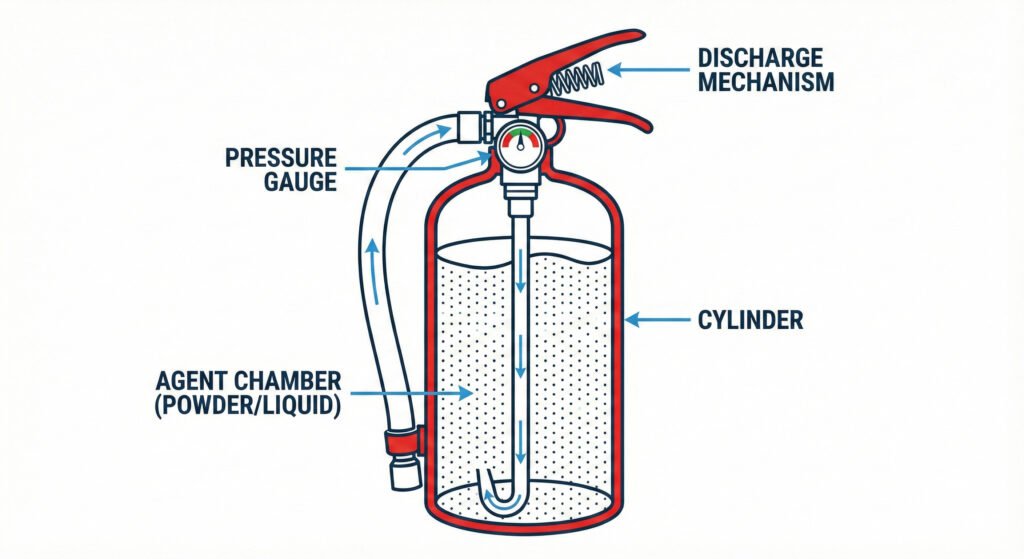
Which Gas is Used in Fire Extinguishers?
The gas used in a fire extinguisher depends on its type and intended purpose. Understanding these gases is essential for selecting the right extinguisher for your needs.
Carbon Dioxide (CO2)
Carbon dioxide is the most common fire-extinguishing gas, particularly effective for Class B flammable liquids and Class C electrical fires. CO2 works through a dual mechanism:
- Oxygen Displacement: Carbon dioxide extinguishes fire primarily by displacing oxygen, though it was once thought to work mainly through cooling
- Cooling Effect: The rapid expansion of CO2 gas creates a cooling effect on the fire source
- Residue-Free: CO2 leaves no residue, making it ideal for protecting sensitive electronic equipment in offices and data centers
Nitrogen
Nitrogen is typically used as a propellant in dry chemical extinguishers, particularly those containing monoammonium phosphate. Nitrogen serves as a pressurising agent, maintaining stable pressure inside the cylinder while remaining non-toxic and non-reactive.
Other Gases
Inert gases like argon are also used in fire suppression, helping to reduce oxygen concentration and suppress combustion without leaving harmful residues. Modern clean agent systems may use specialized compounds like FM-200 or Novec 1230 for protecting sensitive equipment.
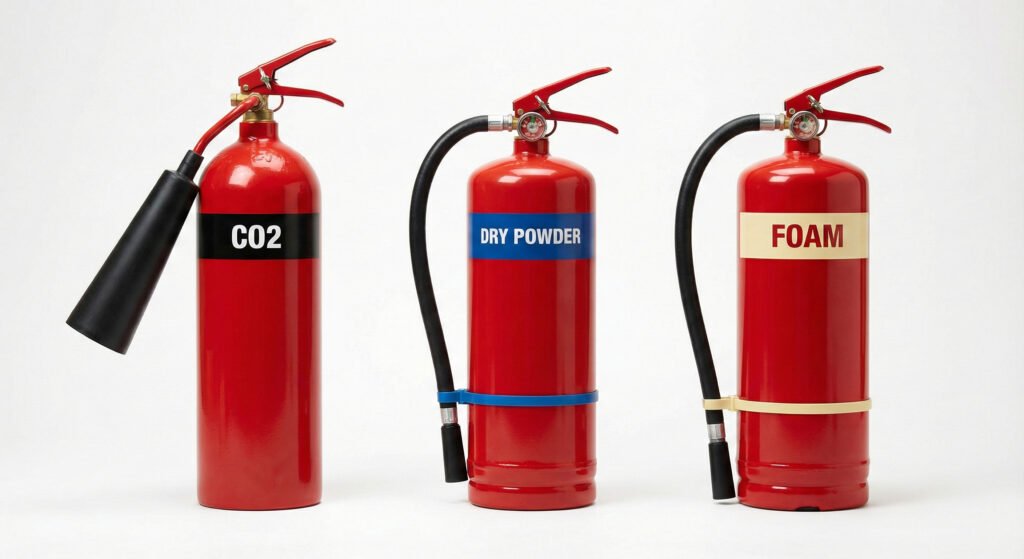
How Many Types of Fire Extinguishers Are There?
Fire extinguishers are classified based on the types of fires they can combat. Understanding these classifications is critical for fire safety.
The Five Main Types
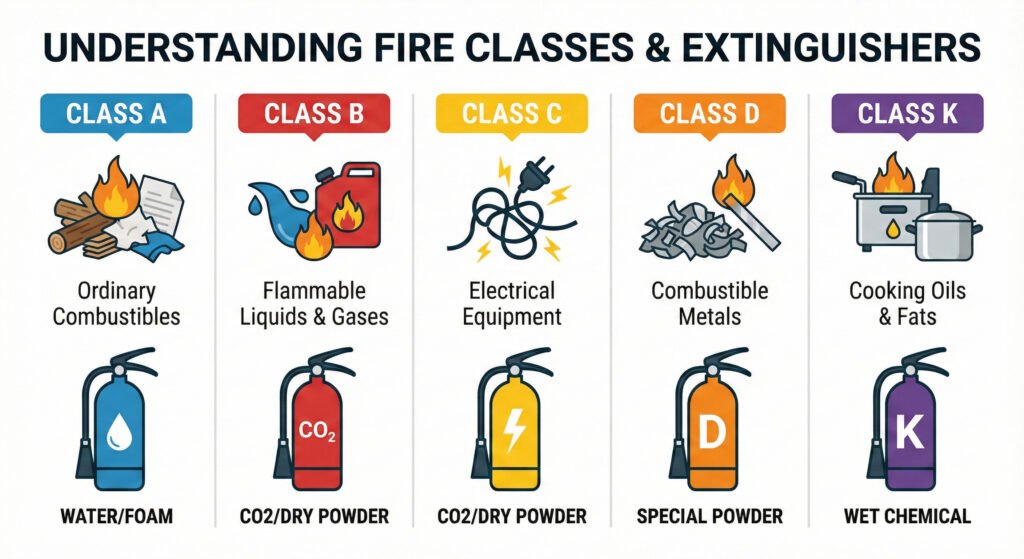
There are five primary types of fire extinguishers, each designed to put out different kinds of fires:
1. Class A Extinguishers
- For: Ordinary combustible materials
- Materials: Wood, cloth, paper, rubber, and many plastics
- Common Type: Water or foam-based
2. Class B Extinguishers
- For: Flammable and combustible liquids
- Materials: Petroleum greases, tars, oils, oil-based paints, solvents, lacquers, alcohols, and flammable gases
- Common Type: CO2 or dry chemical
3. Class C Extinguishers
- For: Electrical fires
- Materials: Power tools, wiring, fuse boxes, appliances, TVs, computers, and electrical motors
- Common Type: CO2 or dry chemical (non-conductive agents)
4. Class D Extinguishers
- For: Combustible metals
- Materials: Magnesium, potassium, titanium, zirconium, lithium, and sodium
- Common Type: Specialised dry powder
5. Class K/F Extinguishers
- For: Kitchen fires
- Materials: Vegetable oils, animal oils, and fats in cooking appliances, often found in commercial kitchens like restaurants and cafeterias
- Common Type: Wet chemical
Multipurpose Extinguishers
Multipurpose fire extinguishers labelled “B-C” or “A-B-C” can be used on multiple types of fires, making them suitable for most home applications.
Which is the Most Common Fire Extinguisher?
Stored-pressure fire extinguishers are the most common type found in buildings. Among the different classes, ABC dry chemical extinguishers are the most popular for general use.
Why ABC Extinguishers Are Popular
ABC extinguishers contain monoammonium phosphate powder and can handle Class A, B, and C fires, making them versatile for most common fire scenarios. These multipurpose units are typically found in:
- Public hallways and corridors
- Office buildings
- Schools and educational facilities
- Retail establishments
- Residential buildings
Water Extinguishers
Water extinguishers are the easiest to maintain and least hazardous since they only contain water, commonly found in shops, offices, schools, hotels, and warehouses.

How Does a Fire Extinguisher Work?
Understanding how fire extinguishers work requires knowing the fundamental principle of fire suppression: the fire triangle.
The Fire Triangle
Fire requires three elements to burn:
- Heat – The energy that starts and sustains combustion
- Fuel – The material that burns
- Oxygen – Supports the combustion process
Fire extinguishers target one or more of these elements: CO2 removes oxygen from the fire zone, nitrogen pressurizes dry chemical powder to coat the fuel, and clean agents stop the fire’s chemical reaction.
Working Mechanisms by Type
Water Extinguishers
Water extinguishers cool the fire by soaking materials with water, extinguishing flames by absorbing heat from burning objects.
CO2 Extinguishers
Carbon dioxide extinguishers displace oxygen around the fire while the cold CO2 provides a cooling effect, effectively suffocating the flames.
Dry Chemical Extinguishers
These work by interrupting the chemical reaction of the fire triangle, creating a barrier between the fuel and oxygen while also suppressing the flames.
Foam Extinguishers
Foam creates a blanket over the fire surface, separating the fuel from oxygen and preventing re-ignition.
How to Operate a Fire Extinguisher: The PASS Method
Knowing how to properly use a fire extinguisher can mean the difference between controlling a fire and facing disaster. The industry-standard method is remembered by the acronym PASS.
The PASS Technique
When operating a fire extinguisher, remember the word PASS: Pull the pin, Aim low, Squeeze the handle, and Sweep.
Let’s break down each step:
P – PULL
Pull the pin that unlocks the operating lever, holding the extinguisher with the nozzle pointing away from you to release the locking mechanism.
A – AIM
Point the extinguisher at the base of the fire, not at the flames themselves. This targets the fuel source rather than just the visible fire.
S – SQUEEZE
Squeeze the lever above the handle to discharge the extinguishing agent, and release the lever to stop discharge.
S – SWEEP
Sweep the nozzle or hose from side to side, moving toward the flames while keeping the extinguisher aimed at the base. Continue until the fire is completely extinguished.
Safety Distance
Keep your back to a clear exit and stand six to eight feet away from the fire when operating the extinguisher.
When Should You Use a Fire Extinguisher?
Not every fire situation calls for using an extinguisher. It’s essential to assess the situation before attempting to fight a fire.
Use a Fire Extinguisher When:
Use a fire extinguisher when you have alerted others in the building, you are physically able to use it, and the fire is small and contained in a single object like a pan or wastebasket.
Additional criteria include:
- Someone has called the fire department
- You have an unobstructed escape route at your back
- The fire is small, confined, and not spreading
- You know what is burning and your extinguisher is appropriate for that fire type
- You have been trained to use the extinguisher
Do NOT Use a Fire Extinguisher When:
If you’re unsure about whether it is safe to use a fire extinguisher, alert others, leave the building, and call 911.
Other dangerous situations include:
- The fire has spread beyond a small area
- Thick smoke fills the room
- You don’t know what’s burning
- The fire blocks your exit route
- You don’t have the correct type of extinguisher
Fire Extinguisher Maintenance and Inspection
Regular maintenance ensures your fire extinguisher will work when you need it most.
Monthly Checks
Check fire extinguishers monthly for accessibility, proper pressure levels shown on gauges, and ensure the can, hoses, and nozzles are not damaged, dented, or rusted.
Maintenance Checklist:
- Accessibility: Nothing blocking reach to the extinguisher
- Pressure: Gauge shows proper pressure levels
- Physical Condition: No dents, rust, or damage
- Cleanliness: Remove any dust, oil, or grease from the outside
- Special Requirements: Some extinguishers need monthly shaking; others require pressure testing every few years
Professional Servicing
Rechargeable extinguishers should receive professional inspection annually and must be recharged after any use, even partial discharge.
Reading Fire Extinguisher Labels
Understanding extinguisher labels helps you select and use the right device.
Classification Numbers
The number before the “A” represents a multiple of 1.25 gallons of water equivalent, while the number before “B” represents the area in square feet of fire that can be extinguished.
For example, a 1A:10B:C rating means:
- 1A: Equivalent to 1.25 gallons of water for Class A fires
- 10B: Can extinguish Class B fires up to 10 square feet
- C: Suitable for Class C electrical fires
Color Coding
In the UK, extinguishers must conform to standards specifying red bodies with small colored bands: red for water, cream for foam, blue for dry powder, yellow for wet chemical, green for clean agent, and black for CO2.
Special Considerations and Safety Tips
Physical Limitations
People with disabilities, older adults, or children may find extinguishers too heavy to handle or too difficult to operate with necessary pressure. Young children and elderly individuals should not attempt to use fire extinguishers.
Training Importance
Contact your local fire department if you would like fire extinguisher training or have questions. Proper training significantly increases the effectiveness of fire extinguisher use during emergencies.
Electrical Fire Warnings
Never use water to extinguish an electrical fire, as water is a good conductor and poses electrocution risks. Always use Class C rated extinguishers for electrical fires.
Historical Context: Evolution of Fire Extinguishers
Understanding the history of fire extinguishers helps us appreciate modern fire safety technology.
The first fire extinguisher on record was patented in England in 1723 by Ambrose Godfrey, consisting of a cask of fire-extinguishing liquid with a pewter chamber of gunpowder.
A portable pressurized fire extinguisher called the ‘Extincteur’ was invented by British Captain George William Manby in 1816, consisting of a copper vessel containing pearl ash solution within compressed air.
The carbon dioxide extinguisher was invented in the United States by the Walter Kidde Company in 1924 in response to Bell Telephone’s request for an electrically non-conductive chemical.
Choosing the Right Fire Extinguisher for Your Space
Selecting appropriate fire extinguishers depends on your environment’s specific hazards.
For Homes:
- ABC multipurpose extinguishers for general protection
- Small kitchen extinguishers (Class K) near cooking areas
- Minimum 5-pound capacity for effectiveness
For Offices:
- CO2 extinguishers near electronic equipment
- ABC extinguishers in hallways and common areas
- Water or foam extinguishers in storage areas
For Industrial Settings:
- Specialized Class D extinguishers where metal fires are risks
- Large capacity units for bigger spaces
- Multiple extinguisher types based on specific hazards
For Vehicles:
- Compact ABC or BC extinguishers
- Securely mounted but easily accessible
- Rated for automotive fires
The Bottom Line: Fire Extinguisher Essentials
Fire extinguishers are indispensable safety devices that can save lives and property when used correctly. Here are the key takeaways:
- Know Your Extinguisher: Understand which type you have and what fires it can handle
- Remember PASS: Pull, Aim, Squeeze, Sweep—the universal method for operation
- Assess Before Acting: Only fight fires that are small, contained, and safe to approach
- Regular Maintenance: Monthly checks and annual professional servicing are essential
- Proper Training: Seek training from your local fire department
- Safety First: When in doubt, evacuate and call emergency services
A portable fire extinguisher can save lives and property by putting out a small fire or containing it until the fire department arrives. By understanding how fire extinguishers work, which gases they use, and how to operate them properly, you’re better prepared to protect yourself, your family, and your property from fire emergencies.
Frequently Asked Questions
Q: How long does a fire extinguisher discharge last? A: Most portable extinguishers discharge for 8-30 seconds, depending on size and type. This makes it crucial to use them effectively and efficiently.
Q: Can I reuse a fire extinguisher after partial use? A: No. Rechargeable extinguishers must be professionally recharged after any use, even partial. Disposable units must be replaced after any discharge.
Q: How often should fire extinguishers be replaced? A: Most disposable extinguishers last 5-15 years. Rechargeable units can last longer with proper maintenance but require professional inspection and servicing.
Q: What should I do immediately after using a fire extinguisher? A: Even if the fire appears out, watch the area carefully for re-ignition. Call the fire department to ensure complete safety. Have the extinguisher professionally recharged or replaced before returning it to service.
Q: Are there fire extinguishers for every type of fire? A: Yes, but no single extinguisher handles all fire types. ABC multipurpose extinguishers cover the most common fire scenarios, but specialized extinguishers are needed for metals (Class D) and commercial kitchen fires (Class K).
Remember: Fire safety is everyone’s responsibility. Equip your space with appropriate fire extinguishers, learn how to use them properly, and never hesitate to call emergency services when facing a fire that’s beyond your ability to control safely.