Confined Space Oxygen Levels: Safe Ranges Complete Guide 2026
Why Oxygen Levels in Confined Spaces Can Kill You Before You Even Realize Something’s Wrong
Here’s the terrifying truth about oxygen in confined spaces.
You can’t smell it dropping. You can’t taste it. You can’t see it disappearing. Your body doesn’t give you a reliable warning until it’s too late. One breath, you’re fine. Three breaths later, you’re unconscious on the floor of a tank that nobody’s watching.
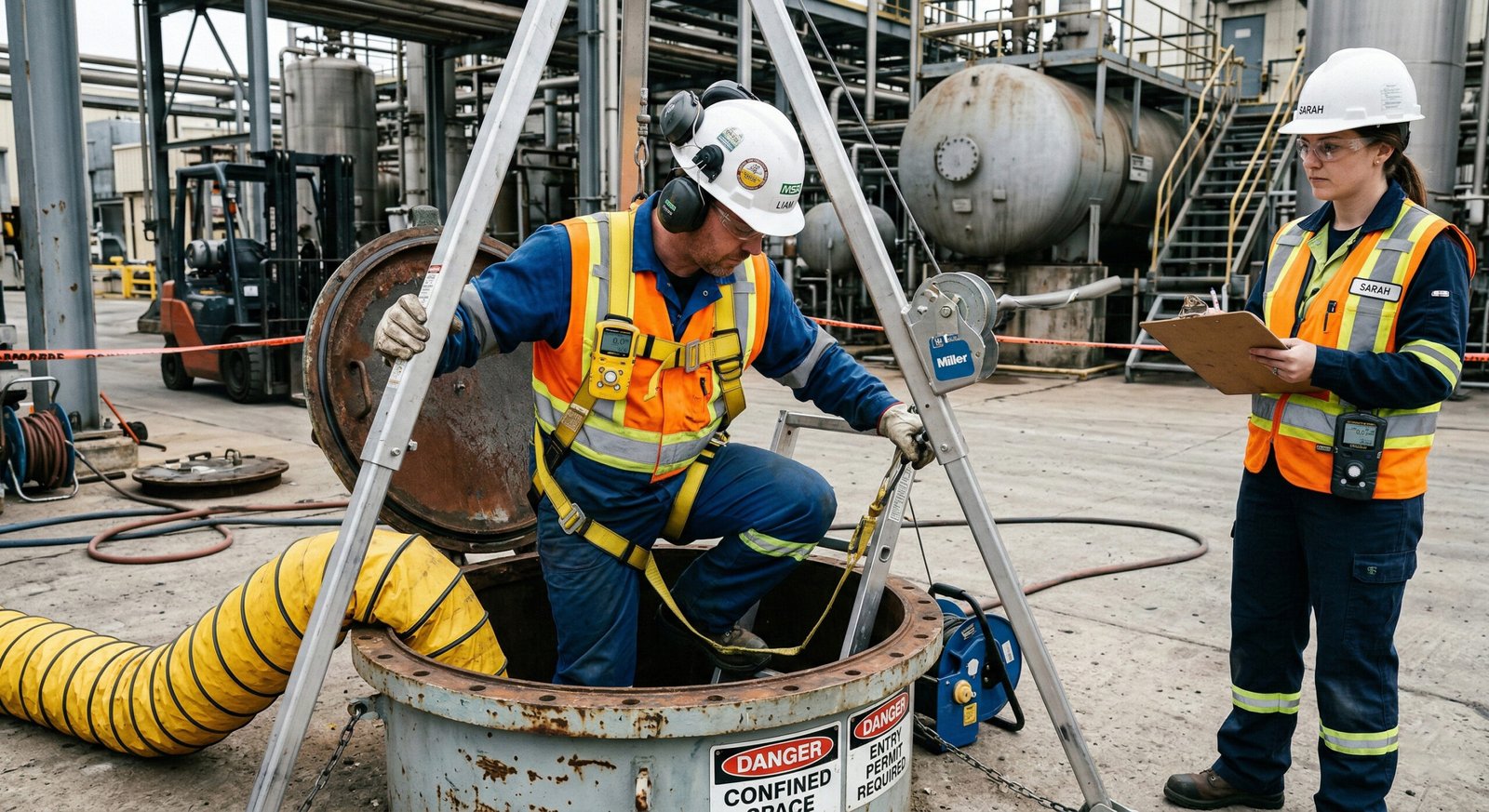
I’ve read dozens of incident investigation reports involving confined space fatalities. The pattern is heartbreaking in its repetition. A worker enters a space without testing the atmosphere. They collapse. A colleague rushes in to help—without testing either. Now you have two victims instead of one. Sometimes three.
Oxygen monitoring isn’t optional. It isn’t a formality. It’s the single most important thing standing between a routine job and a body recovery operation.
Let’s break down exactly what you need to know.
—
What Is the Normal Oxygen Level in Air?
Normal atmospheric air contains 20.9% oxygen. That’s what your lungs are designed to work with. The rest is roughly 78% nitrogen, about 1% argon, and trace amounts of other gases like carbon dioxide.
Your body operates within a surprisingly narrow oxygen window. Even a drop of a few percentage points can impair your thinking, coordination, and consciousness. A larger drop can kill you in minutes.
This is why confined space work treats oxygen monitoring as non-negotiable.
What Is a Safe Oxygen Level in a Confined Space?
According to OSHA (29 CFR 1910.146), the safe oxygen range for confined space entry is:
| Oxygen Level | Classification |
|—|—|
| Below 19.5% | Oxygen Deficient — DANGEROUS |
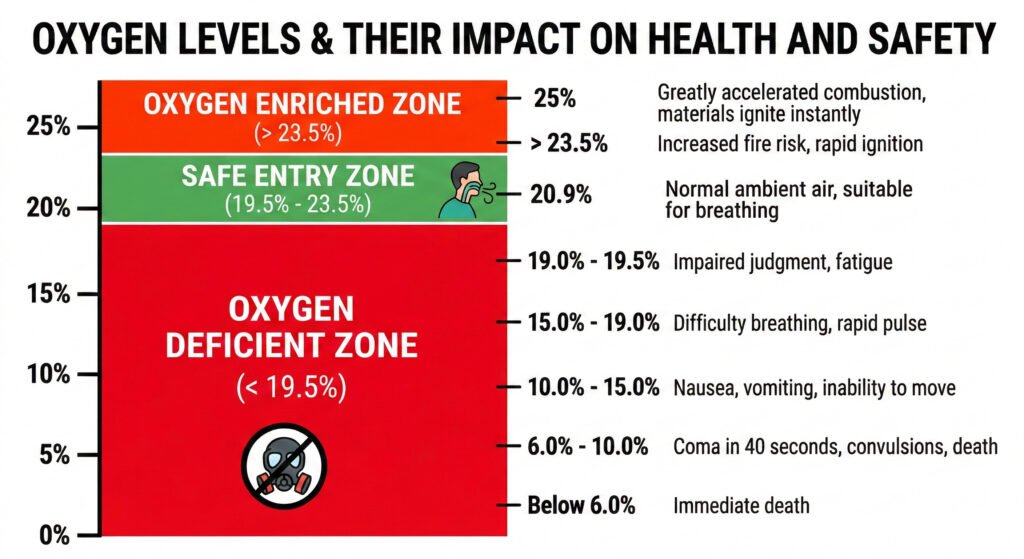
| 19.5% – 23.5% | Acceptable Range — SAFE for entry |
| Above 23.5% | Oxygen Enriched — DANGEROUS |
That’s your window. 19.5% to 23.5%. Anything outside that range and you have a hazardous atmosphere that requires additional controls, ventilation, or—in many cases—prohibition of entry until conditions are corrected.
The UK’s HSE and Australian WHS regulations follow similar principles, though the specific regulatory references differ.
—
—
What Happens at Different Oxygen Levels? The Effects on the Human Body
This is the part that should scare you into never skipping an atmospheric test.
Oxygen Deficient Atmospheres (Below 19.5%)
| Oxygen % | What Happens to You |
|—|—|
| 19.5% | Minimum safe level. No noticeable symptoms for most people. |
| 16 – 19% | Impaired judgment, reduced coordination, faster breathing. You might not even realize you’re affected. |
| 12 – 16% | Rapid breathing, elevated heart rate, headache, poor decision-making. Evacuation still possible but getting difficult. |
| 8 – 12% | Nausea, vomiting, mental failure, unconsciousness within minutes. Self-rescue is unlikely. |
| 6 – 8% | Collapse within seconds. Death within 6-8 minutes without rescue. |
| Below 6% | Almost instant unconsciousness. Fatal within minutes. Gasping, convulsions, cardiac arrest. |
Read that 16-19% band again. Impaired judgment where you might not realize you’re affected. That’s the cruel part. The very organ you need to recognize danger—your brain—is the first thing that stops working properly.
Oxygen Enriched Atmospheres (Above 23.5%)
People tend to focus exclusively on low oxygen. But oxygen enrichment is equally dangerous, just in a different way.
When oxygen levels rise above 23.5%:
– Materials ignite more easily. Things that wouldn’t normally catch fire become flammable.
– Fires burn hotter and faster. A small spark becomes an inferno.
– Clothing can become saturated with oxygen and ignite from friction or a tiny heat source.
– Extinguishing fires becomes extremely difficult in enriched atmospheres.
Oxygen enrichment typically happens near leaking oxygen lines, welding equipment, or in medical and laboratory environments connected to confined spaces.
I spoke to a fire investigator once who told me about a welder whose overalls became oxygen-saturated from a leaking hose in a confined space. When he struck an arc, his clothing ignited instantly. He survived, but with life-changing burns.
It doesn’t take much.
—
What Causes Low Oxygen in Confined Spaces?
Oxygen doesn’t just vanish on its own. Something consumes it, displaces it, or absorbs it. Understanding the causes helps you predict and prevent oxygen-deficient atmospheres.
Common Causes of Oxygen Depletion
– Rusting and oxidation — Steel tanks, vessels, and pipes consume oxygen as they corrode. A sealed tank left for weeks can have severely depleted oxygen levels.
– Biological activity — Decomposing organic matter (sewage, vegetation, food waste) uses up oxygen. Bacteria in sewers and agricultural storage are common culprits.
– Displacement by other gases — Nitrogen, argon, carbon dioxide, methane, or other gases push oxygen out. This happens with purging operations, chemical reactions, or natural gas seepage.
– Combustion — Any burning process inside or near a confined space (welding, cutting, engines running) consumes oxygen rapidly.
– Absorption — Some materials and soils absorb oxygen from the surrounding air.
– Chemical reactions — Certain cleaning agents, curing compounds, or industrial chemicals react with air and reduce oxygen levels.
The critical takeaway: A space that was safe yesterday might not be safe today. Atmospheric conditions in confined spaces can change in hours—sometimes minutes.
—
How Do You Test Oxygen Levels in a Confined Space?
Atmospheric testing isn’t complicated, but it has to be done right.
Before Entry (Pre-Entry Testing)
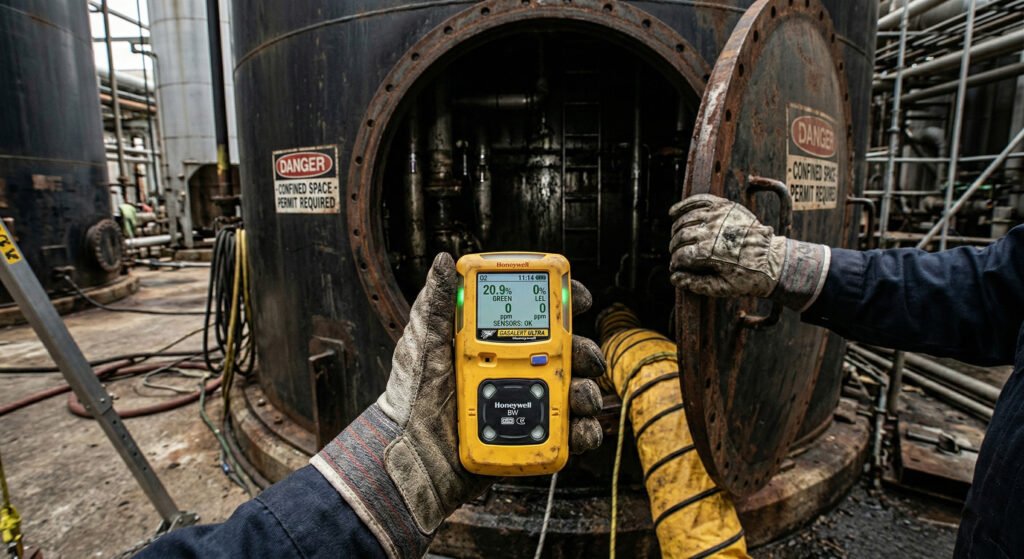
Test the atmosphere before anyone enters using a calibrated, portable gas detector capable of measuring oxygen percentage. Most confined space entries use a 4-gas monitor that simultaneously tests for:
- Oxygen (O2) — percentage in the atmosphere
- Lower Explosive Limit (LEL) — flammable gas/vapor concentration
- Carbon Monoxide (CO)
- Hydrogen Sulfide (H2S)
Testing Procedure
– Test from outside the space first using a remote sampling probe or pump.
– Test at multiple levels — top, middle, and bottom. Different gases have different densities. Heavier gases sink, lighter gases rise. Oxygen depletion may only occur at certain levels within the space.
– Test before and continuously during entry. Conditions change. What reads 20.8% at the opening might read 15% at the bottom.
– Ensure the detector is properly calibrated according to manufacturer specifications. An uncalibrated detector is worse than no detector—it gives you false confidence.
Continuous Monitoring
Once workers are inside, continuous atmospheric monitoring must be maintained throughout the entire duration of the work. If oxygen drops below 19.5% or rises above 23.5%, workers must evacuate immediately.
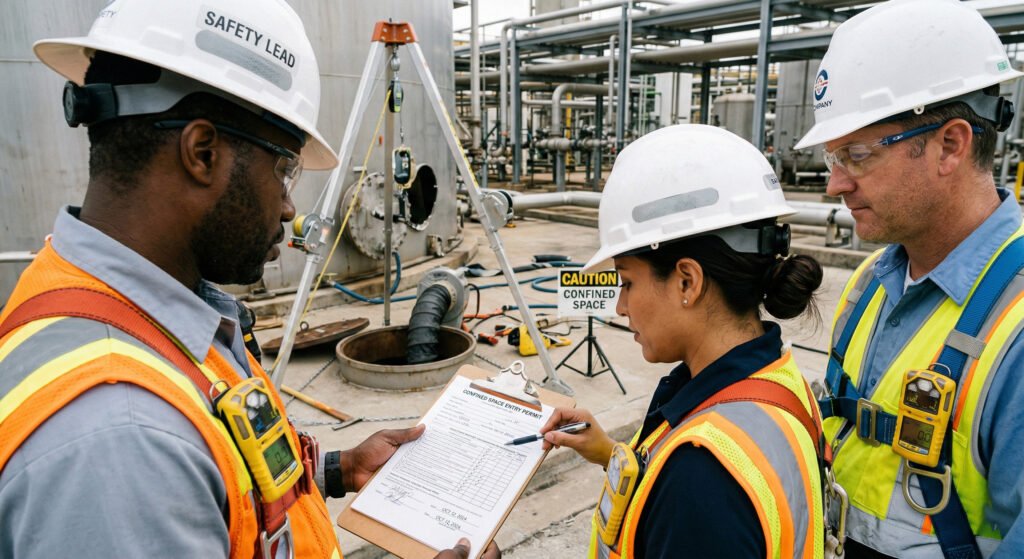
Personal gas monitors worn by each entrant provide real-time warnings. Don’t rely solely on a single detector left at the entry point.
—
What to Do If Oxygen Levels Are Outside the Safe Range
If oxygen is below 19.5%:
- Do not enter. No exceptions.
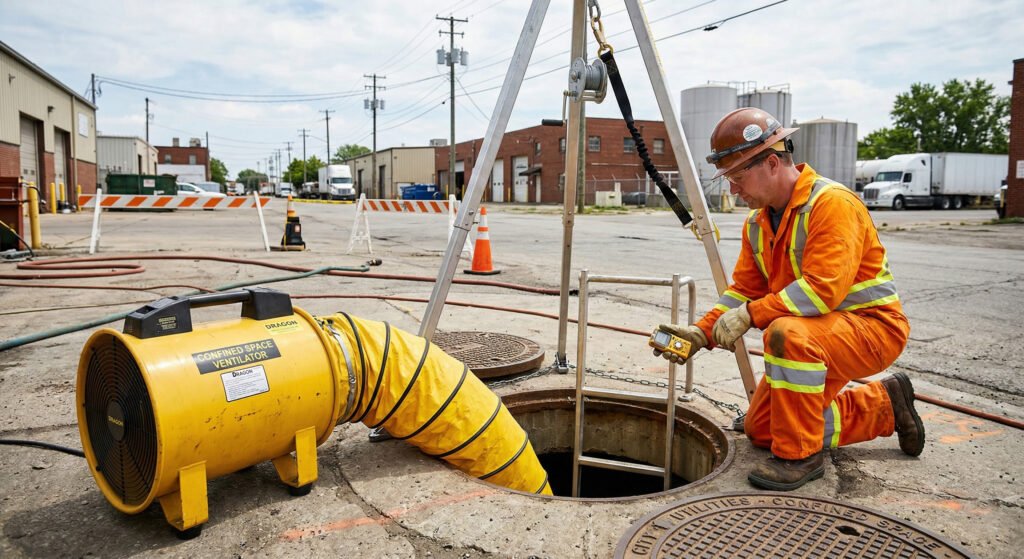
- Ventilate the space using mechanical ventilation (forced air blowers).
- Re-test the atmosphere after ventilation.
- Identify and eliminate the source of oxygen depletion if possible.
- If levels cannot be brought into the safe range, entry requires supplied-air respirators (SCBA or airline systems) and a full rescue plan.
If oxygen is above 23.5%:
- Do not enter. Eliminate all ignition sources.
- Identify the source of oxygen enrichment (leaking lines, cylinders).
- Ventilate the space thoroughly.
- Re-test before allowing entry.
- Remove any oxygen-enriched materials or clothing before reintroduction of ignition sources.
Never use pure oxygen to ventilate a confined space. This is a mistake that has caused multiple fatalities. Always use normal atmospheric air.
—
Legal Requirements You Can’t Ignore
OSHA (United States)
– 29 CFR 1910.146 — Permit-Required Confined Spaces. Requires atmospheric testing, ventilation, entry permits, attendants, and rescue provisions.
– Oxygen must be between 19.5% and 23.5%.
HSE (United Kingdom)
– Confined Spaces Regulations 1997 — Requires risk assessment, safe systems of work, and emergency arrangements. Atmospheric testing is a core component.
Safe Work Australia
– WHS Regulations 2011 — Similar framework requiring atmospheric monitoring, competent persons, and emergency rescue plans.
Across all jurisdictions, the principle is the same: test before you enter, monitor while you’re inside, and have a plan for when things go wrong.
—
Frequently Asked Questions
Can I enter a confined space at 20% oxygen?
Yes. 20% falls within the acceptable range of 19.5%-23.5%. However, you should investigate why it’s dropped from the normal 20.9% and monitor continuously for further decline.
How quickly can oxygen levels drop in a confined space?
Very quickly. In a small, sealed space with an active oxygen-consuming process (rusting, biological decomposition), levels can drop to dangerous concentrations within hours or even minutes.
Is 18% oxygen dangerous?
Absolutely. At 18%, you’re already experiencing impaired coordination and judgment. You may not feel “that bad,” which is exactly what makes it so dangerous.
What gas detector do I need for confined spaces?
A calibrated 4-gas detector measuring O2, LEL, CO, and H2S is the industry standard minimum. Additional sensors may be needed depending on specific hazards present.
Who is responsible for testing the atmosphere?
The entry supervisor or a competent person designated by the employer. Workers should also carry personal monitors as a secondary safeguard.
—
The Bottom Line
Oxygen levels in confined spaces deserve your full attention and absolute respect. The safe window is narrow—19.5% to 23.5%—and the consequences of operating outside that window range from impaired thinking to death.
Test every time. Monitor continuously. Ventilate before entry. Calibrate your equipment. Train your people. Plan your rescue.
The air you breathe shouldn’t be something you gamble on.