

HAZOP: The Complete Guide to Hazard and Operability Studies
Every major industrial disaster has one thing in common — somewhere, someone missed a signal that the system was about to fail.
HAZOP was built specifically to catch those signals before they become tragedies.
Whether you’re an engineer stepping into your first process safety review or a safety manager looking to sharpen your team’s risk methodology, this guide breaks down everything you need to know about HAZOP — what it is, how it works, who runs it, and why it remains the gold standard in industrial risk assessment decades after its invention.
What Is HAZOP? (Hazard and Operability Study)
HAZOP, which stands for Hazard and Operability Study, is a systematic approach to identifying potential problems and issues within complex systems. This structured method is used to uncover safety risks and process inefficiencies by examining both new designs and existing operations.
In plain terms: a HAZOP is a highly structured “what if?” exercise. A team of experts sits down with engineering drawings and process documents and asks — methodically, parameter by parameter — what happens when this system doesn’t behave the way it was designed to?
The methodology involves a multidisciplinary team thoroughly examining process designs using a set of guide words to probe possible deviations from normal operations. These guide words help uncover hidden risks that might not be evident through conventional analysis methods.
HAZOP is a Process Hazard Analysis (PHA) method recognized in OSHA’s Process Safety Management (PSM) standard and is a form of risk management used to identify, evaluate, and control hazards and risks in complex processes.
A Brief History of HAZOP
HAZOP didn’t emerge from an academic lab — it was born out of real industrial necessity.
Historically, HAZOP was developed by Imperial Chemical Industries (ICI) in the 1960s. Its evolution over the decades has seen it become a standard practice in various industries worldwide.
The method was further refined within the company, under the name “operability studies,” and became the third stage of ICI’s hazard analysis procedure. In 1974, a one-week safety course including this procedure was offered by the Institution of Chemical Engineers (IChemE) at Teesside Polytechnic. Coming shortly after the Flixborough disaster, the course was fully booked.
Today, regulators and the process industry at large — including operators and contractors — consider HAZOP a strictly necessary step of project development, at the very least during the detailed design phase.
Why HAZOP Matters: The Stakes Are Real
Let’s put the stakes in perspective with a real example.
The accident occurred when operators started up a tower called a raffinate splitter. The tower and associated piping were over-filled, which led flammable liquid to flow into a blowdown drum that vented to the atmosphere. A large flammable vapor cloud developed, drifted underneath nearby trailers housing contract workers, and was ignited — likely by a running vehicle nearby. Multiple causes led to the incident; however, HAZOP could have played a crucial role in avoiding it.
This wasn’t an isolated event. Incidents like this are exactly why HAZOP exists — to force teams to think through the worst-case deviations before the plant ever runs.
HAZOP vs. HAZID: What’s the Difference?
People often confuse HAZOP with HAZID — and understandably so. Both deal with hazard identification. But they are not the same tool.
Think of HAZID as a preliminary screening tool, and HAZOP as a deeper dive into operational aspects.
HAZID is typically done earlier in a project — at the concept or front-end stage — to get a broad picture of potential risks. It’s faster but less thorough. HAZOP comes later, during detailed design, and goes node by node through every section of a process to examine how each parameter could deviate and what that would actually mean in practice.
Simply put: HAZID asks “what are the hazards?” — HAZOP asks “how exactly could this go wrong, and what would happen?”
Who’s On a HAZOP Team?
A HAZOP study is only as good as the people in the room. One of HAZOP’s greatest strengths is its reliance on diverse expertise.
A HAZOP study is a collaborative effort that requires a multidisciplinary team with diverse expertise and perspectives. Key roles include a Study Leader/Facilitator — an experienced professional responsible for guiding the team through the process — a Recorder/Scribe who documents all discussions and findings, a Design Engineer who provides in-depth knowledge of the system, an Operator who offers practical operational insights, and Subject Matter Experts from disciplines like safety, maintenance, quality, and environmental.
The study leader’s role deserves special attention. This person doesn’t just manage meetings — they set the pace of the review, ensure every guide word gets proper attention, and keep the team from getting stuck in rabbit holes. A weak study leader is one of the fastest ways to end up with a HAZOP report that misses critical risks.
Core HAZOP Concepts You Need to Know
Before walking through the process, it helps to understand the foundational vocabulary of a HAZOP study.
Nodes A HAZOP node refers to a section of a process or system with a defined function and definite boundary. The node needs to be reviewed on a parameter basis to identify any deviation.
Design Intent This is the baseline — how the process is supposed to operate under normal, expected conditions. Everything in a HAZOP is measured against the design intent.
Deviations Deviations are variations from the expected performance or process conditions that could lead to hazardous situations.
Safeguards The HAZOP team looks into the existing system to identify design and operating features which have been implemented to prevent the deviation, cause, or consequence. Safeguards could be an engineering or procedural barrier, and all existing protections should be identified and listed in the HAZOP table.
The 4 Phases of a HAZOP Study
There are four main phases of a HAZOP analysis: preparation, identification, evaluation, and documentation and follow-up.
Phase 1: Preparation
The definition phase typically begins with the preliminary selection of risk assessment team members. After building the team, they must clearly define their responsibilities and identify their objectives and assessment scope — including study boundaries, key interfaces, and assumptions.
Proper preparation involves collecting and reviewing relevant data and documentation, such as process flow diagrams, piping and instrumentation diagrams (P&IDs), material safety data sheets (MSDS), and operating procedures.
Phase 2: Identification (Examination)
This is where the real work happens. The team goes node by node through the process, applying guide words to each parameter to generate potential deviations.
The examination phase begins with the identification of all elements such as parts or steps of the system or process to be examined. The team classifies deviations using guide words on each element and identifies consequences and causes of problems.
Phase 3: Evaluation
In the evaluation phase, the hazards and operability issues that were defined during the identification phase are assessed in terms of their severity, likelihood, and risk. For particularly high-risk deviations, mitigation strategies are also proposed.
Phase 4: Documentation and Follow-Up
All findings from the HAZOP analysis must be documented, including any recommendations for corrective actions and improvements. A follow-up plan should be put in place to ensure that the recommended actions are implemented and reviewed. This documentation can be referred back to for future analyses and audits.
A HAZOP report typically includes an executive summary of key findings, an introduction describing the system and scope, and a methodology section covering the nodes analysed, deviation keywords used, and criteria for evaluating consequences, causes, and safeguards.
HAZOP Guide Words: The Engine of the Method
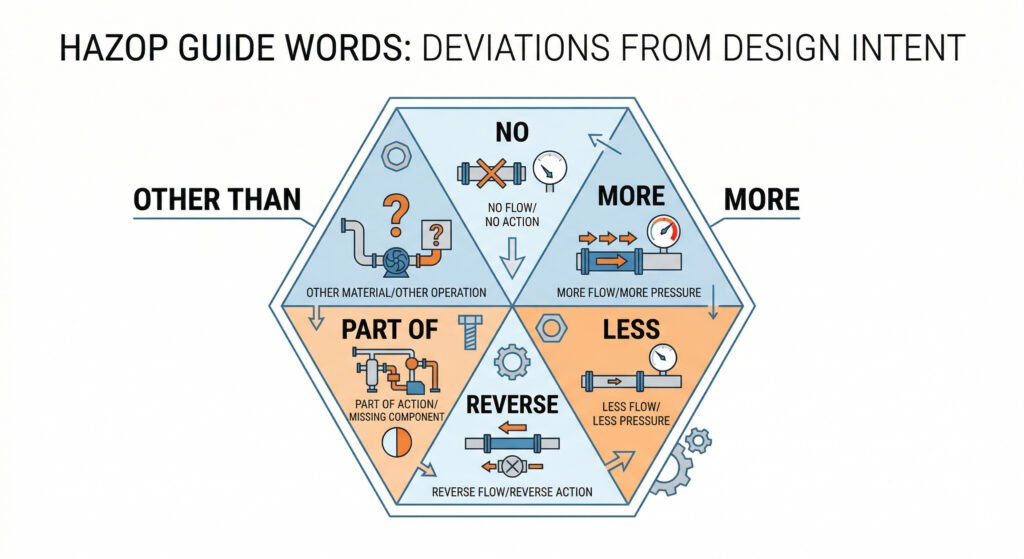
Guide words are the heart of HAZOP. They are short, structured prompts that the team applies to each process parameter to generate deviations systematically.
The team systematically analyses each node using a set of standard deviation keywords, such as “no,” “more,” “less,” “part of,” “reverse,” and “other than.”
Here’s how they work in practice:
| Guide Word | Meaning | Example Deviation |
| No / None | Complete negation of intent | No flow when flow is expected |
| More | Quantitative increase | Higher temperature than designed |
| Less | Quantitative decrease | Lower pressure than required |
| Reverse | Opposite of intent | Backflow in a pipe |
| Part of | Qualitative decrease | Only some components present |
| Other than | Complete substitution | Wrong chemical introduced |
| As well as | Qualitative increase | Additional unexpected phase present |
By applying these guide words to each parameter, the team can explore all possible scenarios and uncover potential hazards or operability issues systematically in a structured and comprehensive manner.
When Should a HAZOP Be Conducted?
Most people associate HAZOP with new plant design — but that’s only one of several triggers.
HAZOP can be applied at other stages, including the later operational life of existing plants, in which case it is usefully applied as a revalidation tool to ensure that poorly managed changes have not crept in since first plant start-up.
The four main scenarios that call for a HAZOP are:
During detailed design — the most common application. The process is defined enough to analyze thoroughly but changes can still be made cost-effectively.
Before process modifications — any significant change to an existing process should be re-evaluated. What was safe before may not be safe with new equipment or operating conditions.
After an incident — a HAZOP can be used retroactively to understand how a near-miss or accident scenario was missed in original reviews.
Periodic revalidation — for long-running facilities, scheduled HAZOP reviews help catch risks introduced by equipment aging, personnel changes, or process drift.
Industries That Rely on HAZOP
HAZOP studies are particularly crucial in high-risk industries such as chemical manufacturing, pharmaceutical production, oil and gas processing, and nuclear power generation.
Beyond these core sectors, HAZOP methodology is increasingly being adopted in water treatment facilities, food and beverage processing, semiconductor fabrication, and even software-controlled automated systems. Anywhere a deviation from normal operation can cause harm — to people, the environment, or assets — HAZOP has a role to play.
Benefits and Limitations of HAZOP
Why HAZOP Works
It’s exhaustive by design. The guide word approach forces the team to consider deviations they might never think of spontaneously.
It’s collaborative. The HAZOP process promotes collaboration among team members as it requires input from various stakeholders, including engineers, operators, maintenance personnel, and safety professionals.
It creates accountability. Every identified risk gets a documented owner and recommended action. Nothing gets lost in conversation.
It satisfies regulators. HAZOP is a Process Hazard Analysis method recognized in OSHA’s Process Safety Management standard, which means passing a HAZOP review is often a legal requirement, not just good practice.
Where HAZOP Has Limits
HAZOP studies can be time-consuming and require significant resources, including personnel and documentation. The process can be complex and may require specialized training, and the quality of the analysis can be influenced by the experience and knowledge of the team members.
Simultaneous occurrence of two unrelated independent incidents is generally not considered due to very low probability — for example, more reactant level and failure of a cooling jacket in a reactor happening at the same time.
This is an important caveat. HAZOP is excellent at identifying single-point deviations, but it can underestimate scenarios that arise from the convergence of multiple rare events. For those cases, tools like LOPA (Layer of Protection Analysis) or fault tree analysis are used to complement HAZOP findings.
HAZOP and Layer of Protection Analysis (LOPA)
While HAZOP is a qualitative study, a Layer of Protection Analysis (LOPA) is semi-quantitative. Engineers implement protections to equipment that prevent the mathematically highest-impact scenarios in terms of risk and probability.
Think of HAZOP and LOPA as partners. HAZOP identifies what could go wrong. LOPA quantifies whether the existing safeguards are actually sufficient to reduce the risk to acceptable levels. Together, they form a robust risk management framework.
Frequently Asked Questions About HAZOP
Q: How long does a HAZOP study take? It depends on the complexity of the process. A simple unit operation might take a few days. A large refinery or chemical plant HAZOP can run for weeks, involving multiple teams working through hundreds of nodes.
Q: Who leads a HAZOP? A trained and experienced HAZOP facilitator, sometimes called a study leader. This person must be neutral — they guide the discussion without pushing the team toward predetermined conclusions.
Q: Is HAZOP mandatory? In many industries and jurisdictions, yes. In the US, OSHA’s PSM standard requires Process Hazard Analysis for facilities handling highly hazardous chemicals above certain thresholds, and HAZOP is one of the accepted methods. In the UK, COMAH regulations have similar requirements.
Q: What’s the difference between HAZOP and a risk assessment? A standard risk assessment identifies hazards and rates their severity and likelihood. HAZOP goes further — it systematically examines how specific process parameters deviate from design intent and traces the causal chain from deviation to consequence to safeguard.
Q: Can HAZOP be done on software or automated systems? Yes. While originally developed for physical process plants, HAZOP methodology has been adapted for software systems, control systems, and procedural HAZOP (reviewing operating procedures rather than P&IDs).