
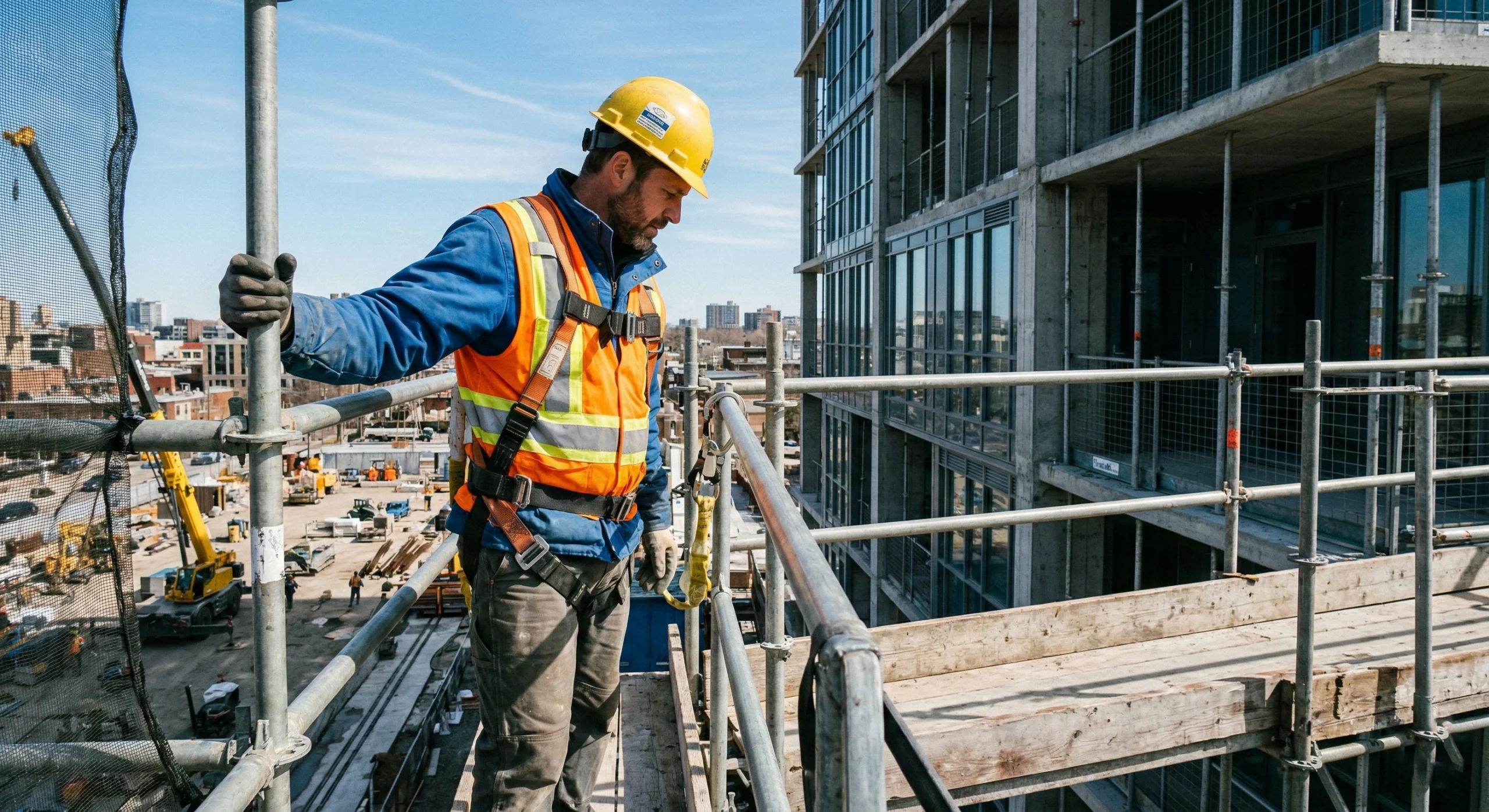
What Exactly Counts as “Working at Height”?
Before we talk hazards, let’s clear up a common misunderstanding.
Working at height doesn’t just mean you’re on top of a skyscraper. Under the Work at Height Regulations 2005 (UK) and similar OSHA standards (US), working at height means any work where a person could fall a distance that would cause personal injury.
That includes:
– Working on a roof
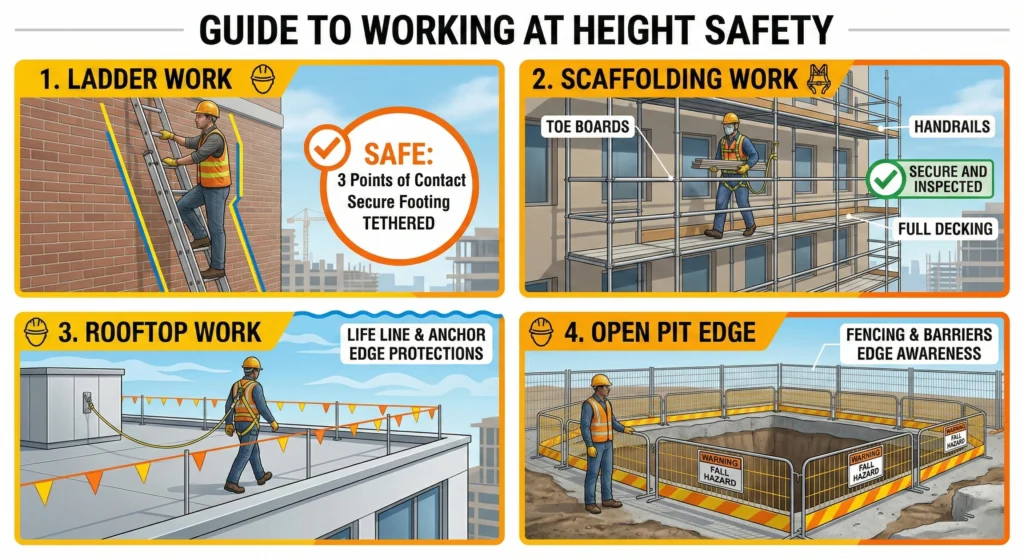
– Standing on a ladder
– Working near an open edge or fragile surface
– Operating on scaffolding
– Using a mobile elevated work platform (MEWP)
– Working near an excavation or pit
– Even standing on a stepladder to change a light fitting
There is no minimum height threshold. If you can fall and get hurt, it counts.
This trips people up constantly. I’ve seen businesses ignore safety protocols because “it’s only two metres.” Two metres is more than enough to cause a fatal head injury.
—
The 12 Most Dangerous Working at Height Hazards
Here’s what you’re really up against. I’ve organized these from the most common killers to the less obvious (but equally dangerous) risks.
- Falls From Edges and Open Sides
This is the number one killer. Unprotected edges on roofs, platforms, mezzanine floors, and scaffolding are responsible for more fatal falls than anything else.
Why it happens:
– Edge protection wasn’t installed
– Guardrails were removed and never replaced
– Workers moved beyond the protected zone
– Temporary works changed the layout and nobody updated the barriers
The UK’s HSE has found that a significant proportion of fatal falls happen from edges where protection either wasn’t there or had been taken down for “just a few minutes.”
There’s no such thing as a few minutes when gravity is involved.
—
-
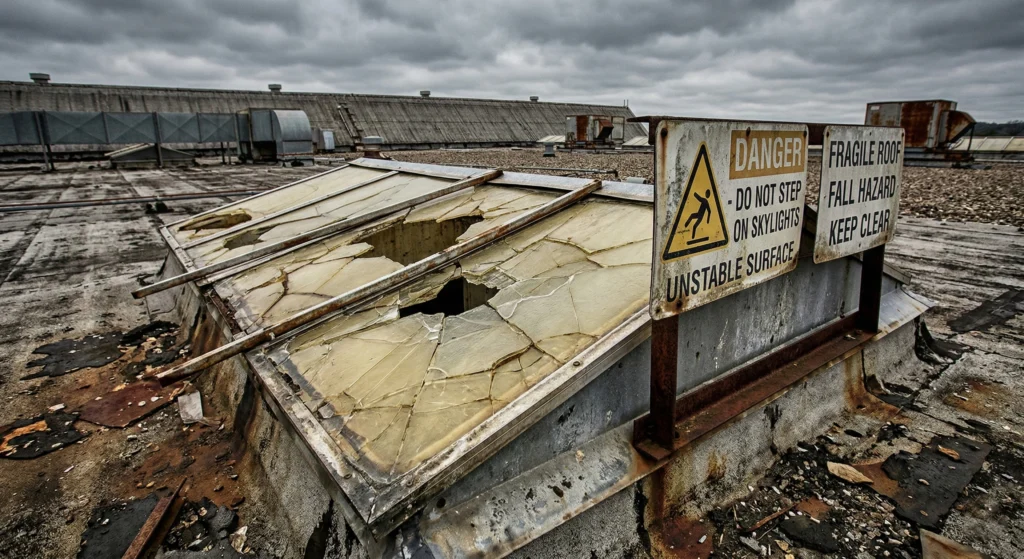
Falls Through Fragile Surfaces
Fragile roofs are silent killers. Cement fibre sheets, skylights, corroded metal roofing, glass panels, and even aged industrial roofing—these surfaces look solid until someone steps on them.
Real-world example: A maintenance worker steps onto what appears to be a solid industrial roof to inspect HVAC equipment. One panel is a skylight covered in grime and dirt. He steps on it. Falls straight through.
Falls through fragile surfaces account for a disproportionately high number of fatalities compared to the time spent working on them. The fall distances tend to be significant, and there’s often nothing below to break the fall.
Key point: If you haven’t verified it’s safe to stand on, assume it isn’t.
-
Ladder-Related Falls
Ladders are the most commonly used access equipment—and one of the most commonly misused.
Common ladder hazards include:
– Using a damaged or defective ladder
– Placing the ladder on uneven or soft ground
– Over-reaching while on the ladder
– Using the wrong type of ladder for the job
– Carrying tools or materials while climbing
– Not maintaining three points of contact
– Leaning the ladder at the wrong angle (the 4:1 rule gets ignored constantly)
Here’s what a lot of people don’t realize: ladders should be your last resort, not your first choice. The hierarchy of controls says you should only use a ladder when the task is low-risk and short-duration, and there’s no better alternative.
I can’t tell you how many incident reports I’ve read where someone fell off a ladder doing a job that should’ve been done from a scaffold or a MEWP.
—
-
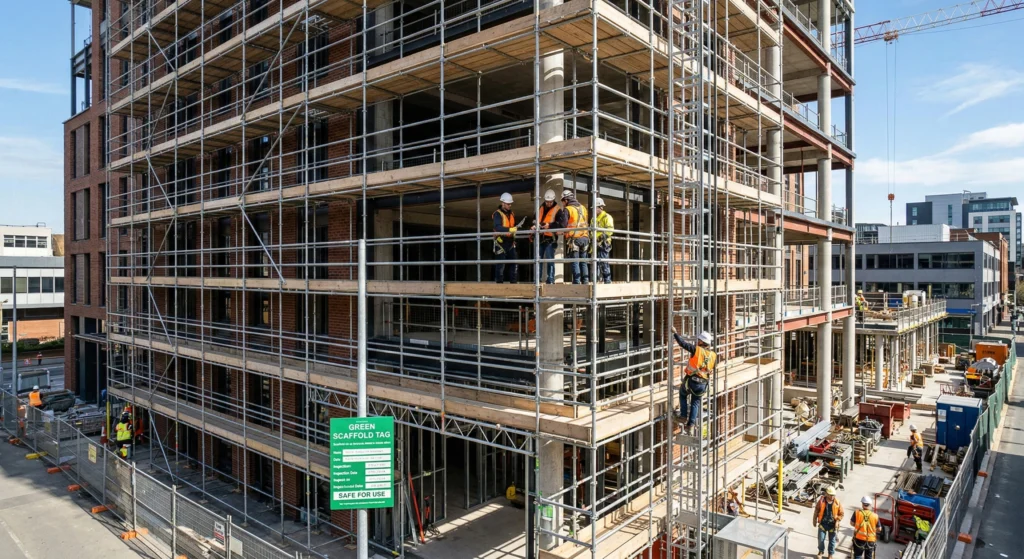
Scaffold Collapses and Failures
Scaffolding is supposed to be the safer option. And it is—when it’s done right. When it’s not, the consequences are catastrophic.
Scaffold hazards include:
– Inadequate foundations or base plates
– Missing guardrails, toe boards, or mid-rails
– Overloading the platform with materials or workers
– Unauthorized modifications by unqualified workers
– Incomplete scaffolds being used before they’re signed off
– Weather damage (wind, rain, frost) weakening the structure
– Not conducting regular inspections
In the UK, scaffolding must be erected and inspected by a competent person. It must be inspected before first use, after any alteration, after any event that could affect stability (like a storm), and at regular intervals not exceeding 7 days.
Ignoring these inspections is not just negligent—it’s criminal.
—
-
Falling Objects
You don’t have to fall yourself to become a victim of working at height. Objects falling from height injure and kill people on the ground every year.
What falls?
– Hand tools (spanners, hammers, drills)
– Building materials (bricks, blocks, timber)
– Personal items (phones, water bottles)
– Debris from cutting, drilling, or demolition work
– Unsecured equipment
A one-kilogram tool dropped from just 10 metres hits the ground with enough force to cause a fatal head injury, even through a standard hard hat.
Prevention isn’t complicated:
– Use tool lanyards and tethering systems
– Install toe boards on all platforms
– Set up debris nets and fans
– Establish exclusion zones below working areas
– Secure all materials against displacement
—
-
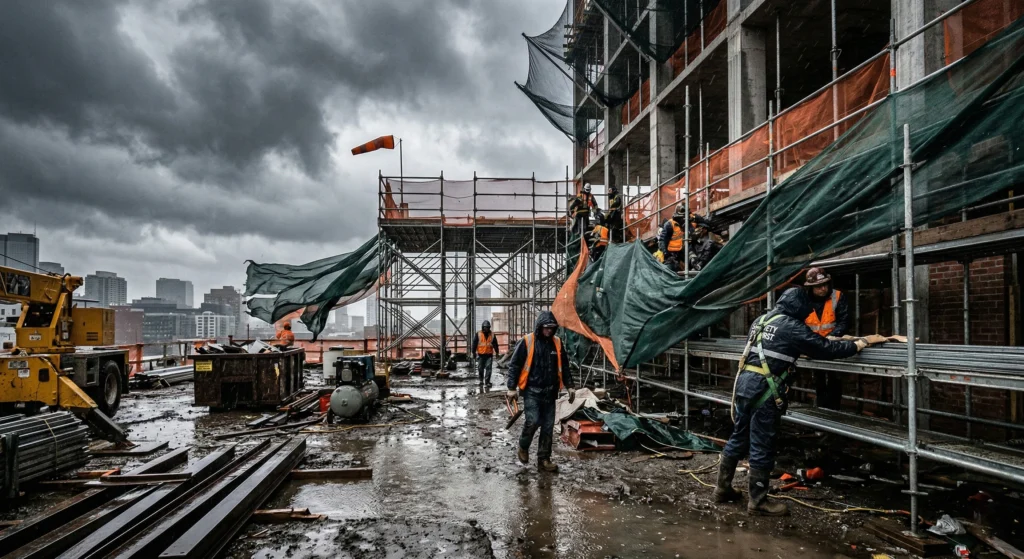
Adverse Weather Conditions
Wind, rain, ice, snow, fog, and extreme heat all dramatically increase the risk of falls from height.
Here’s how:
– Wind: Can destabilize ladders, blow workers off balance, catch large panels or sheets acting as sails
– Rain and ice: Make surfaces slippery, reduce grip on handholds, affect equipment performance
– Fog: Reduces visibility, making it harder to judge distances and identify edges
– Heat: Causes fatigue, dizziness, dehydration—leading to lapses in concentration
– Lightning: Direct strike risk on exposed elevated positions
Most working at height regulations require that work be postponed or stopped when weather conditions make it unsafe. In practice, project deadlines push people to keep going. This is where strong site leadership becomes critical.
—
—
- Inadequate or Defective Equipment
Using worn-out harnesses, frayed lanyards, cracked ladder rungs, corroded anchor points, or malfunctioning MEWPs is a recipe for disaster.
Equipment-related hazards:
– Harnesses that haven’t been inspected or are past their service life
– Lanyards that are too long (allowing the worker to hit the ground before the fall is arrested)
– Anchor points that aren’t rated for the load
– Cherry pickers with hydraulic faults
– Scaffolding components with visible damage or corrosion
What you should be doing:
– Pre-use visual checks every single time
– Formal inspections at required intervals (typically every 6 or 12 months depending on equipment type)
– Immediate removal of defective equipment from service
– Keeping records of all inspections and maintenance
I’ve personally seen a harness pass a visual check but fail under load during testing because of internal webbing degradation that wasn’t visible from outside. Trust the inspection schedule.
—
-
Lack of Training and Competence
This one underpins almost every other hazard on this list.
An untrained worker doesn’t know how to:
– Properly inspect their equipment
– Identify fragile surfaces
– Set up a ladder at the correct angle
– Use fall arrest systems properly
– Recognize when conditions are too dangerous
The regulations are clear. Anyone who works at height, supervises work at height, or plans work at height must be competent. That means they’ve received adequate training, have relevant experience, and possess enough knowledge to identify risks.
Simply handing someone a harness and pointing them toward the roof doesn’t count.
—
-
Poor Planning and Risk Assessment
A surprising number of working at height incidents come down to one simple failure: nobody actually planned the work properly.
Common planning failures:
– No site-specific risk assessment was conducted
– The risk assessment was generic and didn’t address actual conditions
– Nobody identified the need for edge protection before work started
– Emergency rescue procedures weren’t established
– The wrong equipment was selected for the task
Under the Work at Height Regulations, every piece of work at height must be planned. The planning should address what equipment will be used, who will do the work, what hazards exist, and what will happen if something goes wrong.
A method statement without a proper risk assessment is just paperwork.
—
-
Incorrect Use of Mobile Elevated Work Platforms (MEWPs)
Cherry pickers, scissor lifts, boom lifts—MEWPs are incredibly useful, but they come with their own set of serious hazards.
MEWP hazards include:
– Overturning due to uneven ground, overloading, or wind
– Collision with overhead structures, power lines, or other vehicles
– Workers being catapulted or ejected from the basket
– Entrapment or crushing between the platform and fixed structures
– Mechanical failure during operation
Critically, operators must be trained and authorized. And the work area must be assessed for ground conditions, overhead obstructions, pedestrian traffic, and slope gradients before the MEWP is even brought on site.
Too many operators learn on the job without formal certification. This isn’t acceptable.
—
-
Structural Instability
Sometimes the hazard isn’t the height itself—it’s the structure you’re standing on.
Examples:
– Roofs weakened by rot, corrosion, or age
– Partially constructed buildings where floors and beams aren’t secured
– Temporary structures that haven’t been properly braced
– Surfaces that have been weakened by fire, water damage, or chemical exposure
Before anyone works at height, the structural integrity of the working surface must be assessed. If there’s any doubt, a structural engineer should be consulted.
—
-
Failure to Plan for Rescue
Here’s something that gets overlooked far too often: what happens after a fall?
If a worker is wearing a harness and they fall, they don’t just hang there safely forever. Suspension trauma (also called harness-induced pathology) can cause serious injury or death within 15 to 20 minutes if the worker isn’t rescued promptly.
Blood pools in the legs, circulation fails, and the worker can go into cardiac arrest even after being rescued if the recovery isn’t handled correctly.
Every working at height plan must include:
– A specific rescue procedure
– Trained rescue personnel on site or immediately available
– Rescue equipment readily accessible (rescue kits, descent devices)
– Communication systems that allow a fallen worker to call for help
If your rescue plan is “call 999 and wait,” you don’t have a rescue plan.
—
—
The Hierarchy of Control for Working at Height
The law requires a clear hierarchy when it comes to managing working at height risks. You don’t just pick whatever control measure is most convenient—you work through these steps in order:
Step 1: Avoid work at height entirely.
Can the task be done from the ground? Can you use extendable tools, drones for inspections, or prefabricate components at ground level?
Step 2: Prevent falls from occurring.
If height work is unavoidable, use platforms with guardrails, podium steps, scaffolding with full edge protection, or MEWPs with proper controls.
Step 3: Minimize the distance and consequences of a fall.
If you can’t fully prevent falls, use safety nets, soft-landing systems, airbags, or personal fall arrest systems (harnesses with appropriate lanyards and anchor points).
Too many workplaces jump straight to Step 3 (handing out harnesses) without even considering Steps 1 and 2. That’s not just poor practice—it’s a legal failure.
—
Who Is Responsible for Safety When Working at Height?
Responsibility is shared, but the weight falls heaviest on employers and duty holders.
Employers must:
– Ensure all work at height is properly planned, supervised, and carried out by competent people
– Provide appropriate equipment that is regularly inspected
– Conduct suitable risk assessments
– Provide adequate training
– Ensure emergency and rescue procedures are in place
Employees must:
– Follow the training and instructions they’ve received
– Use equipment correctly
– Report any hazards, defects, or unsafe conditions immediately
– Not take unnecessary risks
Self-employed workers carry responsibilities equivalent to both employer and employee.
Clients, designers, and principal contractors under CDM Regulations (UK) also have duties related to working at height during design and construction phases.
There is no passing the buck on this. If someone falls because you didn’t do your part, you will be held accountable.
—
Working at Height Regulations: What Does the Law Say?
In the UK:
The Work at Height Regulations 2005 apply to all work at height where there is a risk of a fall that could cause personal injury. Key requirements include:
– Work at height must be avoided where possible
– Where it can’t be avoided, it must be properly planned and organized
– Those involved must be competent
– Risks must be assessed, and appropriate equipment must be selected
– Equipment must be properly inspected and maintained
– Weather conditions must be considered
– Emergency and rescue plans must be in place
In the US:
OSHA’s Fall Protection Standards (29 CFR 1926 Subpart M for construction and 29 CFR 1910 Subpart D for general industry) require:
– Fall protection at 6 feet (1.8m) in construction
– Fall protection at 4 feet (1.2m) in general industry
– Guardrail systems, safety net systems, or personal fall arrest systems
– Training for workers exposed to fall hazards
– Proper inspection and maintenance of fall protection equipment
In Australia:
The Work Health and Safety Regulations 2011 define working at height and require a risk management approach similar to the UK model.
Regardless of where you operate, the core principles are the same: avoid, prevent, protect.
—