
Turn ESG Requirements into Business Opportunities
Environmental, Social and Governance expectations are changing the way organisations are evaluated by investors, customers, lenders, employees, regulators and global supply chains.
For many organisations, ESG begins as a compliance requirement.
Handled strategically, however, ESG can become much more than reporting. It can help identify opportunities to reduce costs, improve resource efficiency, strengthen governance, manage operational and supply-chain risks, build stakeholder confidence and position the organisation for sustainable long-term growth.
Safety Catch ESG Consulting & Opportunities helps organisations understand where they stand, determine what matters most, develop a practical ESG strategy and convert sustainability challenges into measurable improvement opportunities.
Our approach connects ESG strategy with business performance.
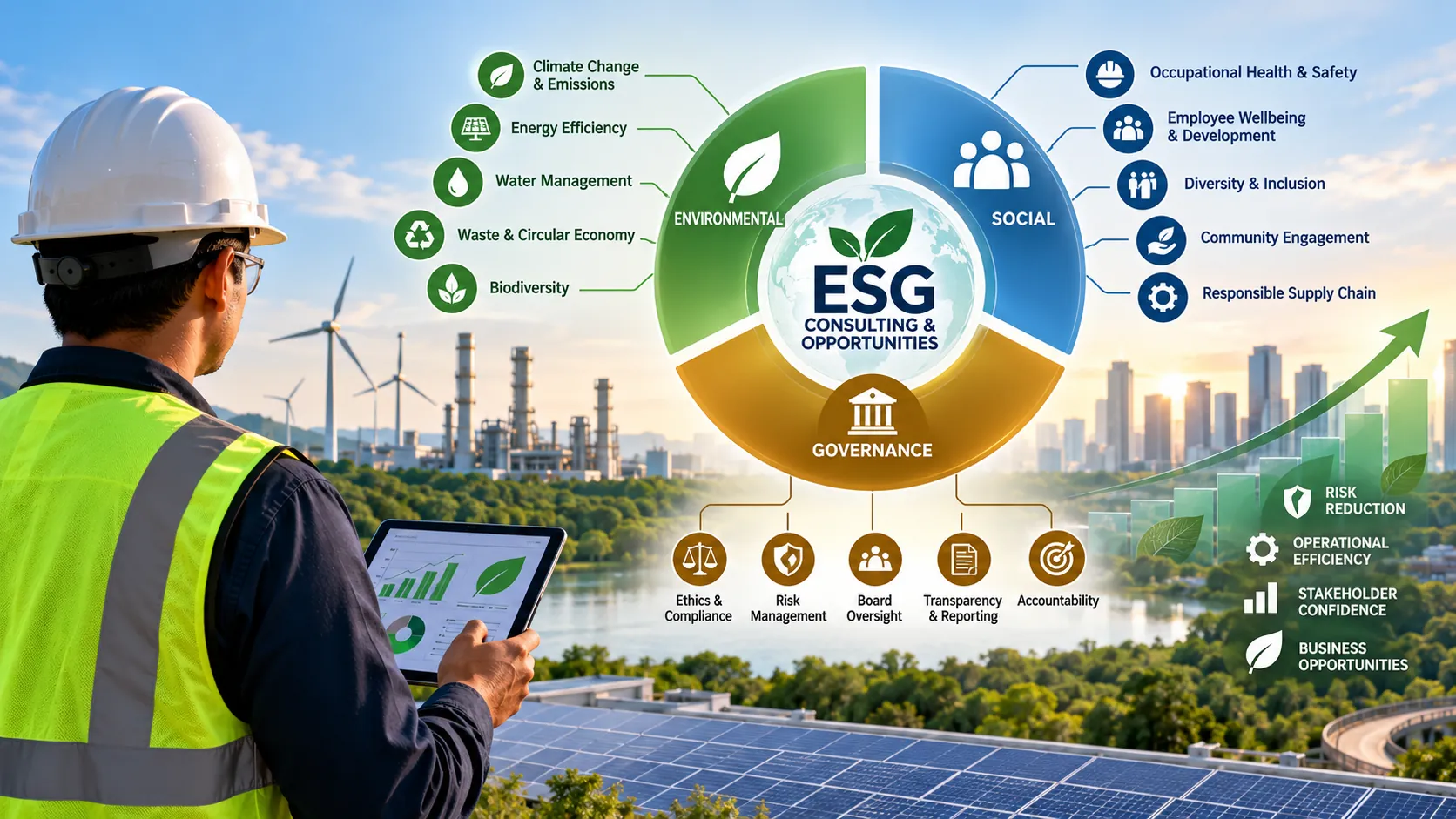
Strong ESG performance requires the organisation to understand:
- What environmental and social impacts it creates
- What sustainability-related risks can affect the business
- What stakeholders expect
- Where significant data gaps exist
- Which ESG issues are material
- What improvement opportunities are available
- Which targets are realistic
- Who is responsible for delivery
- How progress will be measured
- How ESG performance will be communicated credibly
Safety Catch helps organisations move from ESG intention to ESG implementation.
ESG Is More Than a Sustainability Report
Publishing an ESG or sustainability report does not, by itself, make an organisation sustainable.
What Does ESG Mean for Your Business?
Environmental
The Environmental dimension considers how the organisation interacts with the natural environment and manages issues such as:
- Climate change
- Greenhouse gas emissions
- Energy consumption
- Renewable energy
- Water management
- Waste management
- Circular economy
- Pollution prevention
- Natural-resource consumption
- Biodiversity
- Environmental compliance
- Sustainable procurement
- Environmental performance
The objective is not simply to reduce environmental impact.
Organisations should also identify where better environmental performance can reduce operating costs, improve efficiency, strengthen resilience and create new business opportunities.
Social
The Social dimension considers how an organisation manages its relationship with employees, contractors, customers, communities and other people affected by its activities.
Key areas may include:
- Occupational Health & Safety
- Employee wellbeing
- Human rights
- Labour practices
- Diversity and inclusion
- Learning and development
- Employee engagement
- Contractor welfare
- Community relations
- Product responsibility
- Customer safety
- Supply-chain social performance
For organisations with significant industrial or project activities, occupational health and safety is an important component of social performance.
Safety Catch’s established HSE capability enables us to connect ESG commitments with actual workplace safety, worker wellbeing and contractor-management practices.
Governance
Governance determines how ESG commitments are directed, controlled, monitored and communicated.
Key areas may include:
- Board oversight
- Management accountability
- Business ethics
- Anti-bribery and corruption
- Compliance
- Risk management
- Policies and procedures
- Internal controls
- ESG responsibilities
- Data governance
- Whistleblower mechanisms
- Stakeholder accountability
- Performance monitoring
- Disclosure controls
Without strong governance, environmental and social commitments may remain disconnected initiatives.
Effective ESG therefore requires clear leadership, ownership, measurement and accountability.

Our ESG Consulting Services
Safety Catch provides customised ESG consulting support according to the organisation’s size, sector, maturity, stakeholder requirements and business objectives.
Our services can be delivered individually or as part of an integrated ESG transformation programme.
ESG Readiness & Gap Assessment
Every successful ESG programme should begin by understanding the organisation’s current position.
Safety Catch can conduct an ESG readiness or gap assessment covering areas such as:
- Existing ESG policies
- Governance arrangements
- Environmental performance
- Occupational health and safety
- Human capital
- Social responsibility
- Ethics and compliance
- Stakeholder engagement
- Risk management
- Supply-chain controls
- Sustainability data
- Performance indicators
- Reporting practices
- Targets and commitments
The assessment identifies:
- What already exists
- What is working
- What is missing
- What requires improvement
- What should be prioritised
The result provides management with a clear starting point for developing the ESG roadmap.
Safety Catch can help organisations develop a practical ESG strategy covering:
- ESG vision
- Strategic priorities
- Material ESG issues
- Governance arrangements
- Responsibilities
- Risk and opportunity management
- Objectives
- Performance indicators
- Targets
- Implementation programmes
- Reporting requirements
- Review mechanisms
The strategy is designed to answer three important questions:
- Where are we now?
- Where do we want to be?
- How will we get there?
ESG Strategy Development
An effective ESG strategy should support the organisation’s broader business strategy rather than operate as an isolated sustainability initiative.
ESG Materiality Assessment
Not every ESG issue has the same significance for every organisation.
A materiality assessment helps identify the environmental, social and governance matters that deserve the greatest management attention.
Safety Catch can support organisations in identifying material topics through:
- Business-context review
- Industry analysis
- Stakeholder expectations
- Operational impacts
- Risk assessment
- Regulatory requirements
- Customer requirements
- Supply-chain expectations
- Management consultation
- Employee input
- Existing performance data
Material topics can then be prioritised and incorporated into ESG strategy, metrics, targets and reporting.
ESG Risk & Opportunity Assessment
ESG should not be considered only from a risk perspective.
Every significant ESG issue may present both risk and opportunity.
Safety Catch helps organisations systematically identify these factors.
Typical ESG Risks
Potential risks may include:
- Increasing energy costs
- Climate-related disruptions
- Water scarcity
- Waste-management failures
- Environmental non-compliance
- Occupational injuries
- Workforce shortages
- Contractor failures
- Supply-chain disruption
- Human-rights concerns
- Governance failures
- Reputational damage
- Customer requirements
- Loss of market eligibility
Potential ESG Opportunities
Opportunities may include:
- Energy efficiency
- Reduced material consumption
- Waste reduction
- Resource recovery
- Renewable-energy adoption
- Lower operating costs
- Safer workplaces
- Improved workforce retention
- Better contractor performance
- Sustainable procurement
- Green products and services
- Supply-chain qualification
- Improved customer confidence
- Access to new markets
- Enhanced business resilience
Our objective is to help management see ESG not simply as “What could go wrong?”, but also “Where can we create value?”
ESG Opportunity Identification
This is a key feature of the Safety Catch approach.
Once the ESG baseline has been established, we work with organisations to identify realistic opportunities for improvement and value creation.
Opportunities may exist in areas such as:
Energy
- Reduction in energy intensity
- Equipment efficiency
- Building optimisation
- Renewable-energy opportunities
- Operational controls
- Monitoring and measurement
Water
- Consumption reduction
- Leak management
- Reuse opportunities
- Process optimisation
- Water-risk management
Waste & Circularity
- Waste minimisation
- Segregation improvement
- Material recovery
- Recycling
- Reuse
- Packaging optimisation
- Circular-economy opportunities
Occupational Health & Safety
- Serious-risk reduction
- Contractor safety
- Health-risk management
- Worker participation
- Safety culture
- Leadership engagement
People
- Employee development
- Workforce engagement
- Wellbeing
- Diversity
- Retention
- Competency improvement
Supply Chain
- Responsible sourcing
- Supplier evaluation
- ESG requirements
- Contractor governance
- Supply-chain transparency
- Local procurement opportunities
Governance
- Clear ESG accountability
- Improved decision-making
- Risk integration
- Better data controls
- Transparent reporting
- Stronger ethical-management systems
Each opportunity should ultimately answer a business question:
What improvement can be achieved, what resources are required and what value can it create?
ESG Roadmap Development
Once priorities are established, Safety Catch can translate ESG strategy into an implementation roadmap.
The roadmap can define:
- Priority initiative
- Required action
- Responsible function
- Performance indicator
- Target
- Timeline
- Resources
- Dependencies
- Monitoring method
- Reporting frequency
Initiatives can be organised into:
Immediate Actions
Issues requiring urgent attention or relatively simple improvements.
Short-Term Actions
Projects that can be implemented within the initial phase of the ESG programme.
Medium-Term Actions
Initiatives requiring investment, organisational change or system development.
Long-Term Transformation
Strategic programmes connected with long-term sustainability and business objectives.
This allows management to move from a broad ESG ambition to a practical sequence of actions.
Safety Catch can help organisations establish or strengthen:
- ESG Policy
- Sustainability Policy
- ESG Committee Structure
- Board / Senior Management Oversight
- ESG Roles and Responsibilities
- Responsibility Matrix
- Reporting Lines
- Management Review
- ESG Risk Escalation
- Data Ownership
- Performance Review
- Stakeholder Communication
Governance arrangements should make it clear who owns ESG performance and who is accountable for results.
ESG Policy & Governance Framework
Effective ESG requires clear governance.
ESG KPI & Target Development
An organisation cannot manage ESG performance effectively without meaningful measurement.
Safety Catch can support development of ESG metrics covering areas such as:
- Energy consumption
- GHG emissions
- Water consumption
- Waste generation
- Recycling
- Environmental incidents
- Occupational injuries
- Lost-time incidents
- Training
- Employee turnover
- Diversity
- Community engagement
- Supplier performance
- Compliance
- Ethics
- Governance activities
Metrics should be relevant to the organisation and useful for management decision-making.
Where appropriate, baseline values can be established and measurable targets developed.
Safety Catch can support organisations in establishing a structured approach to areas such as:
- Greenhouse-gas inventory planning
- Emission-source identification
- Scope 1, Scope 2 and relevant Scope 3 data planning
- Energy review
- Emission-reduction opportunities
- Climate-related risks
- Physical risks
- Transition risks
- Climate objectives
- Reduction roadmaps
- Performance monitoring
Where specialist carbon-accounting or verification requirements apply, suitable technical expertise can be incorporated into the assignment.
Carbon & Climate Strategy Support
Climate-related issues are increasingly important in corporate sustainability planning.
ESG Data Management
One of the biggest challenges in ESG reporting is often not writing the report.
It is obtaining reliable data.
Environmental, social and governance information may be spread across:
- HR
- HSE
- Operations
- Procurement
- Finance
- Facilities
- Legal
- Compliance
- Supply Chain
- Corporate Affairs
- Project Teams
Safety Catch can help organisations create an ESG data-management structure defining:
- Required data
- Data source
- Data owner
- Measurement method
- Frequency
- Supporting evidence
- Validation process
- Approval responsibility
- Reporting requirement
Better ESG reporting begins with better ESG data.
ESG Reporting Support
Safety Catch can support organisations in organising and communicating sustainability information in a structured and credible manner.
Depending on organisational requirements, reporting support may consider applicable frameworks and stakeholder expectations such as:
- BRSR / BRSR Core
- GRI Standards
- IFRS Sustainability Disclosure Standards / ISSB
- SASB industry-based guidance
Greenhouse Gas Protocol
and other applicable customer, investor or regulatory requirements.
Support can include:
- Reporting-gap assessment
- Data collection structure
- Material-topic identification
- KPI development
- Narrative development
- Evidence review
- Disclosure mapping
- Management review
- Report structure
- Improvement recommendations
The objective is to help organisations communicate ESG performance using reliable, consistent and decision-useful information.
Safety Catch can provide support in areas such as:
- BRSR readiness assessment
- BRSR data mapping
- Responsibility allocation
- KPI identification
- Evidence requirements
- Environmental information
- Employee and workforce information
- Occupational health and safety information
- Supply-chain information
- Governance data
- Gap closure
- Reporting preparation
- Assurance readiness
For organisations supplying listed companies, increasing ESG expectations within the value chain can also make ESG capability commercially relevant even when the supplier itself is not directly subject to the same reporting obligations.
BRSR & BRSR Core Support
For organisations operating within the Indian corporate environment, Business Responsibility and Sustainability Reporting has become an important part of the ESG landscape.
GRI Reporting Support
Safety Catch can support organisations wishing to structure sustainability reporting around relevant GRI requirements.
The process can include:
- Identification of relevant impacts
- Material-topic assessment
- Stakeholder considerations
- Data-gap analysis
- Disclosure mapping
- Performance data
- Management approach
- Report-development support
GRI-based reporting can help organisations communicate their environmental, social and economic impacts in a structured sustainability-reporting format.
Safety Catch can help organisations evaluate readiness relating to areas such as:
- Governance
- Strategy
- Sustainability-related risks and opportunities
- Risk-management processes
- Metrics and targets
- Climate-related risks
- Climate-related opportunities
- Data availability
- Management responsibilities
The purpose of readiness support is to identify gaps between existing sustainability information and the information the organisation may need to manage or disclose.
ISSB / IFRS Sustainability Disclosure Readiness
Investor-focused sustainability disclosures are increasingly connecting ESG information with financial decision-making.
ESG Supply-Chain Readiness
Large organisations increasingly request ESG information from suppliers, contractors and business partners.
This means ESG can affect not only listed companies but also organisations that want to remain part of major corporate and international supply chains.
Safety Catch can support suppliers and contractors in strengthening:
- Environmental practices
- Worker health and safety
- Labour practices
- Ethics and governance
- Compliance systems
- ESG policies
- Sustainability data
- Supplier questionnaires
- Customer ESG assessments
- Evidence management
Strong ESG capability can help organisations respond more effectively to increasingly demanding customer prequalification and procurement requirements.
Safety Catch can help develop supplier and contractor ESG-management arrangements including:
- Supplier ESG Code
- ESG Prequalification Criteria
- Supplier Questionnaires
- Risk-Based Supplier Classification
- Environmental Requirements
- Health & Safety Requirements
- Labour and Human-Rights Criteria
- Ethical Requirements
- Supplier Performance Monitoring
- Corrective-Action Systems
- Supplier Development Programmes
This helps organisations translate corporate ESG commitments into supply-chain expectations.
Sustainable Procurement & Supplier ESG
An organisation’s ESG footprint extends beyond its own premises.
ESG & Occupational Health and Safety
One of Safety Catch’s strongest contributions to ESG is our background in Occupational Health & Safety.
Employee and contractor safety should not exist only as numbers within a sustainability report.
Organisations need systems that actually prevent injuries, protect health and improve working conditions.
Safety Catch can connect ESG social commitments with practical programmes involving:
- Safety management systems
- Risk management
- Worker consultation
- Occupational health
- Contractor safety
- Safety leadership
- Behavioural safety
- Competency development
- Incident prevention
- Performance measurement
This creates a stronger link between reported ESG performance and actual workplace performance.
Safety Catch can help organisations improve readiness by reviewing:
- Data ownership
- Source records
- Calculation methods
- Evidence availability
- Internal controls
- Data consistency
- Approval processes
- Reporting boundaries
- Performance claims
- Supporting documentation
The objective is to make ESG information more traceable, supportable and verifiable.
Where independent assurance is required, it should be performed separately by a suitably qualified and independent assurance provider.
ESG Assurance Readiness
ESG information may be subject to increasing scrutiny from management, customers, investors, regulators and independent assurance providers.
Avoiding Greenwashing
ESG communication should reflect actual performance.
Organisations can create significant reputational risk when sustainability claims are stronger than the evidence supporting them.
Safety Catch encourages an evidence-based approach in which:
- Targets are realistic
- Claims can be supported
- Performance data can be traced
- Limitations are acknowledged
- Progress is measured
- Responsibility is clear
The strongest ESG message is not the most ambitious statement.
It is the statement that the organisation can demonstrate through credible action and evidence.
ESG Improvement Programme
For organisations seeking more than a one-time assessment, Safety Catch can develop a structured ESG improvement programme.
A typical programme may include:
Phase 1 – Understand
- ESG readiness assessment
- Stakeholder requirements
- Data review
- Materiality
- Risk and opportunity identification
Phase 2 – Design
- ESG strategy
- Governance framework
- Policies
- KPIs
- Targets
- Implementation roadmap
Phase 3 – Implement
- Improvement projects
- Department responsibilities
- Data systems
- Training
- Supply-chain initiatives
- Operational integration
Phase 4 – Measure
- Performance monitoring
- KPI reviews
- Progress reporting
- Management review
Phase 5 – Communicate
- Sustainability reporting
- Stakeholder communication
- Disclosure support
- Assurance readiness
Phase 6 – Improve
- Gap closure
- New opportunities
- Performance improvement
- Strategy review
- Continual improvement
This creates an ESG management cycle rather than an annual reporting exercise.
Our ESG Consulting Methodology
Discover
Understand the organisation’s business, operations, stakeholders and sustainability context.
Assess
Determine existing ESG maturity, risks, data availability and performance gaps.
Prioritise
Identify material ESG issues and the areas offering the greatest risk reduction or business opportunity.
Strategise
Develop ESG priorities, governance, objectives and targets.
Implement
Translate strategy into practical projects, systems and responsibilities.
Measure
Develop KPIs, data systems and performance-monitoring processes.
Report
Support credible disclosure aligned with applicable frameworks and stakeholder expectations.
Improve
Use performance information to identify further opportunities and strengthen ESG maturity.
Where ESG Can Create Business Value
ESG should ultimately support better organisational decisions.
Potential value may come through:
Operational Efficiency
Lower energy, water, material and waste costs.
Risk Reduction
Better visibility and control of environmental, social, supply-chain and governance risks.
Customer & Supply-Chain Readiness
Improved ability to respond to ESG requirements from major clients and global organisations.
Stronger Workforce Performance
Better safety, engagement, wellbeing, competency and retention.
Improved Governance
Clearer accountability, stronger controls and better management information.
Reputation & Stakeholder Confidence
More credible communication supported by actual performance.
Business Resilience
Greater preparedness for environmental, climate, workforce and supply-chain disruption.
Innovation
Identification of new products, services, processes and operating models connected with sustainability.
Market Opportunities
Better positioning where customers, tenders or supply chains include ESG requirements.
ESG should therefore be approached not simply as a reporting cost, but as an opportunity to improve how the organisation operates.
- Listed Companies
- Large Corporates
- EPC Companies
- Construction Organisations
- Manufacturers
- Energy Companies
- Renewable-Energy Organisations
- Infrastructure Companies
- Industrial Facilities
- Exporters
- Contractors
- Suppliers to Large Corporations
- SMEs Beginning Their ESG Journey
- Organisations Preparing Sustainability Reports
- Companies Responding to Customer ESG Requirements
The ESG solution is customised according to each organisation’s maturity and requirements.
Who Can Benefit?
Safety Catch ESG Consulting & Opportunities services can support:
Flexible ESG Engagement Models
ESG Readiness Assessment
For organisations wanting to understand their current ESG position.
ESG Strategy Project
For organisations requiring a complete strategy and implementation roadmap.
ESG Reporting Support
For organisations preparing structured sustainability disclosures.
ESG Improvement Programme
For organisations wanting to convert assessment findings into measurable improvement projects.
Supply-Chain ESG Programme
For organisations seeking to strengthen supplier and contractor sustainability performance.
Retained ESG Advisory
For organisations requiring ongoing professional guidance as ESG requirements evolve.
Why Choose Safety Catch?
Strong HSE Foundation
Environmental management, occupational health, safety and workforce wellbeing are significant components of ESG performance. Safety Catch brings practical experience in these areas.
Business-Oriented Approach
We focus not only on ESG compliance but also on opportunities for efficiency, risk reduction and performance improvement.
Practical Implementation
Our recommendations are designed to be translated into real actions, responsibilities and measurable results.
Integrated Capability
ESG strategy can be connected with OHS management, environmental programmes, risk management, contractor management, training and organisational performance.
Customised Solutions
Different organisations have different impacts, risks, stakeholders and levels of ESG maturity. Our services are therefore designed around the client rather than a generic template.
Capability Building
We work with internal teams so that ESG knowledge and responsibility remain within the organisation.
Experience Across Industry
Safety Catch has supported organisations and professionals across industrial, construction, infrastructure, energy and corporate sectors since 2010.
Find the Opportunity Inside Your ESG Challenge
A strong ESG programme should do more than produce disclosures.
It should help management understand the organisation better.
- Where are resources being wasted?
- Where are people exposed to unnecessary risk?
- Where is the organisation vulnerable?
- What are customers beginning to expect?
- What ESG requirements could affect future business?
- Where can efficiency improve?
- Where can sustainability create competitive advantage?
These are the questions that turn ESG from compliance into opportunity.
Measure What Matters. Improve What Matters. Create Sustainable Value.
Safety Catch can help your organisation assess its ESG maturity, identify risks and opportunities, develop a practical ESG strategy and translate sustainability commitments into measurable action.
Talk to Our ESG Consulting Team
- Since 2010 | 35,000+ Trained | 250+ Clients | 4 Countries