
Build the Knowledge. Develop the Capability. Put ESG into Action.
Environmental, Social and Governance performance cannot be built by a sustainability team working alone.
Effective ESG requires people across the organisation—from the boardroom to operations, HSE, HR, finance, procurement, supply chain and project teams—to understand what ESG means, why it matters and what they are expected to do.
Safety Catch ESG Training Services help organisations build the knowledge and practical capability required to understand, implement, measure and communicate ESG performance.
Our programmes are designed for different organisational levels and professional roles—from introductory ESG awareness for employees to advanced workshops for management teams, sustainability professionals and ESG report preparers.
The focus is not simply on understanding ESG terminology.
It is on helping participants answer:
- What does ESG mean for our organisation?
- What are our responsibilities?
- What should we measure?
- What risks and opportunities should we manage?
- How do we translate ESG commitments into action?
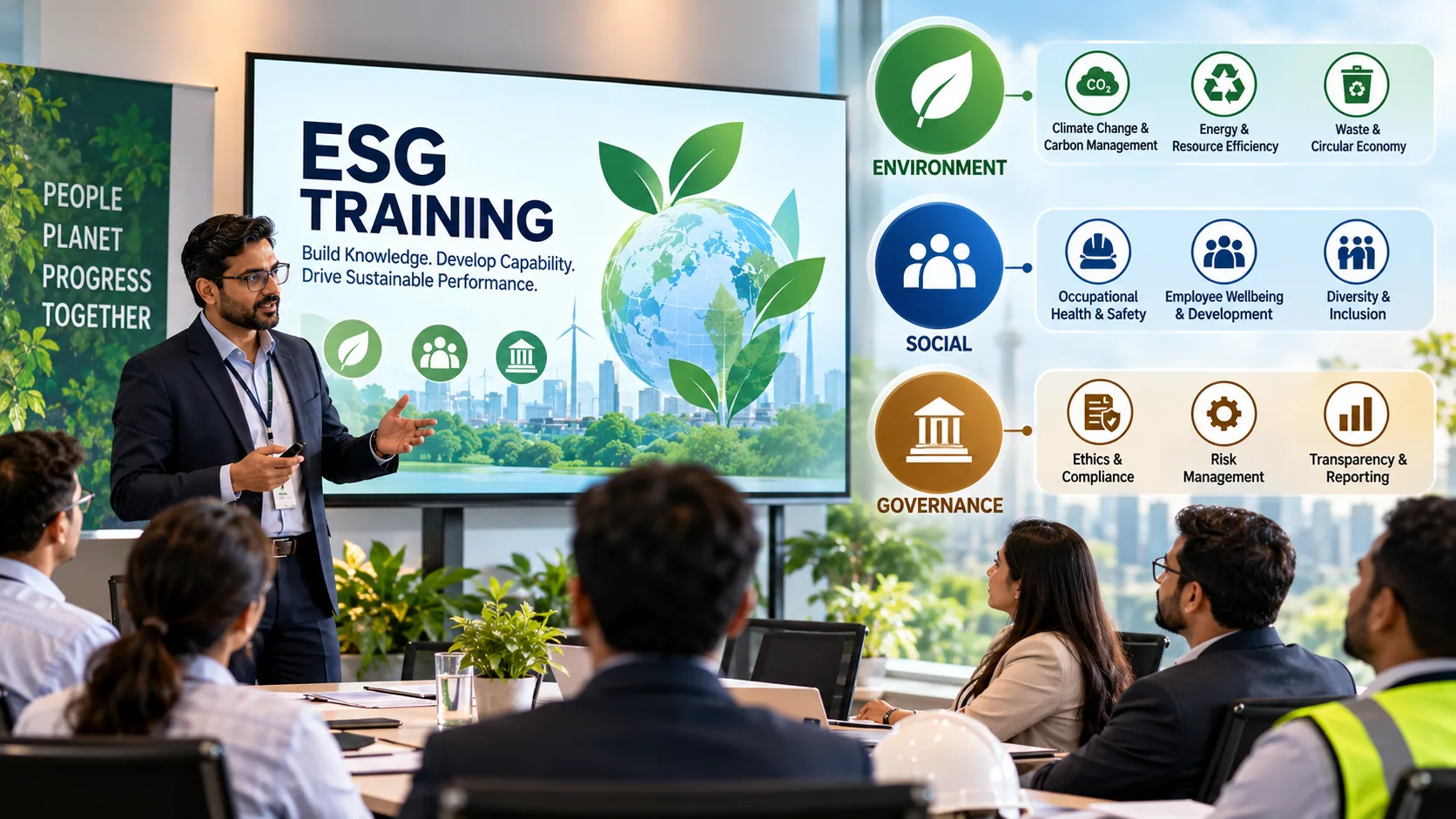

ESG Capability Starts with People
Organisations may develop ESG policies, targets and sustainability reports, but effective implementation depends on the people responsible for delivering them.
Management must understand ESG-related business risks and opportunities.
Operational teams must understand environmental impacts and resource efficiency.
HSE professionals must understand how occupational health and safety contributes to the Social dimension.
HR teams must understand workforce, diversity, wellbeing and human-capital expectations.
Procurement teams must understand supply-chain ESG requirements.
Finance and reporting teams must understand sustainability-related information and disclosure requirements.
Senior leadership must understand governance, accountability and ESG performance.
This is why ESG training should not be treated as a single generic awareness programme.
Different roles require different ESG competencies.
Safety Catch designs ESG training around those competencies.
Our ESG Training Portfolio
Safety Catch can provide individual programmes or develop a complete organisation-wide ESG learning framework.
Our training services can include:
- ESG Awareness
- ESG for Senior Management & Leadership
- ESG Strategy & Implementation
- Environmental Sustainability Management
- ESG Reporting & Disclosure
- BRSR & BRSR Core
- GRI Sustainability Reporting
- IFRS S1 & S2 Awareness
- Climate Change & Carbon Management
- Greenhouse Gas Awareness
- ESG Risk & Opportunity Management
- Materiality Assessment
- Sustainable Supply Chain & Procurement
- ESG for HSE Professionals
- Social Sustainability & Workforce ESG
- ESG Governance
- ESG Data & KPI Management
- ESG Assurance Readiness
ESG for Contractors & Suppliers
Programmes can be customised according to organisational requirements, industry sector and participant profile.
ESG Awareness Training
Understanding ESG and Why It Matters
This introductory programme provides employees and professionals with a practical understanding of Environmental, Social and Governance concepts.
Key Learning Areas
- What ESG means
- Evolution of sustainability and ESG
- Difference between ESG, CSR and sustainability
- Environmental factors
- Social factors
- Governance factors
- Stakeholder expectations
- ESG risks and opportunities
- Business impact of ESG
- Individual employee responsibilities
- Practical workplace ESG actions
Suitable For
- Employees
- Supervisors
- Executives
- New ESG Team Members
- HSE Personnel
- HR Professionals
- Operations Teams
- Corporate Functions
Outcome
Participants develop a common ESG vocabulary and understand how their individual roles contribute to organisational sustainability performance.
ESG for Senior Management & Leadership
ESG as a Business and Governance Issue
Senior leaders do not necessarily need to become ESG technical specialists.
They do need to understand how sustainability-related risks and opportunities can influence strategy, investment, reputation, operations, supply chains and long-term organisational performance.
Key Learning Areas
- ESG business context
- Board and management responsibilities
- Material ESG issues
- ESG risks and opportunities
- Strategic integration
- Stakeholder expectations
- Governance structures
- ESG accountability
- Performance indicators
- Targets and commitments
- Greenwashing risk
- Sustainability disclosures
- Management oversight
- Decision-making using ESG information
Suitable For
- Board Members
- CEOs
- Managing Directors
- Business Heads
- Project Directors
- Senior Management
- Functional Heads
Outcome
Leadership teams gain the knowledge required to provide informed oversight, ask the right questions and integrate ESG considerations into business decisions.
ESG Strategy & Implementation Training
From ESG Commitments to Measurable Action
This programme helps participants understand how an ESG strategy is developed and converted into a practical implementation roadmap.
Key Learning Areas
- Understanding organisational ESG context
- Baseline assessment
- Stakeholder identification
- Materiality
- Risk and opportunity assessment
- ESG strategic priorities
- Governance
- Objectives and targets
- ESG KPIs
- Department responsibilities
- Implementation roadmap
- Data requirements
- Monitoring
- Management review
- Continual improvement
Practical Exercise
Participants can work through a simulated organisation and develop:
ESG Priorities → Objectives → KPIs → Actions → Responsibilities → Targets
Outcome
Participants understand how to move from broad ESG ambitions to a structured and manageable implementation programme.
Environmental Sustainability Management Training
Safety Catch’s Environmental Sustainability Management programme develops practical capability in managing the Environmental component of ESG.
Key Learning Areas
- Environmental sustainability principles
- Environmental aspects and impacts
- Environmental regulatory awareness
- Energy management
- Energy efficiency
- Water management
- Waste minimisation
- Waste hierarchy
- Circular economy
- Pollution prevention
- Resource efficiency
- Biodiversity awareness
- Climate change
- Greenhouse-gas emissions
- Environmental KPIs
- Sustainability reporting
- Continual improvement
Suitable For
- Environmental Managers
- HSE Managers
- Facility Managers
- Operations Managers
- Engineers
- Sustainability Professionals
- Project Personnel
Outcome
Participants develop practical knowledge for identifying environmental impacts and implementing measurable sustainability improvements.
ESG Reporting & Disclosure Training
Turning ESG Performance into Credible Information
ESG reporting requires more than writing attractive sustainability narratives.
Participants must understand what information stakeholders require, where the information comes from and how it can be supported.
Key Learning Areas
- Purpose of sustainability reporting
- ESG reporting landscape
- Material information
- Reporting boundaries
- ESG data
- Quantitative and qualitative disclosures
- Environmental metrics
- Social metrics
- Governance metrics
- Evidence requirements
- Data validation
- Report structure
- Performance narratives
- Target reporting
- Credibility and transparency
- Avoiding unsupported claims
- Assurance readiness
Outcome
Participants understand how organisational ESG activity can be transformed into consistent, traceable and decision-useful reporting information.
BRSR & BRSR Core Training
Understanding India's Business Responsibility & Sustainability Reporting Framework
This programme is designed for professionals who need to understand the structure, data requirements and organisational responsibilities associated with Business Responsibility and Sustainability Reporting.
Key Learning Areas
- ESG reporting in the Indian context
- Introduction to BRSR
- BRSR architecture
- General disclosures
- Management and process disclosures
- Principle-wise performance disclosures
- Essential indicators
- Leadership indicators
- BRSR Core
- ESG attributes
- Data ownership
- Environmental information
- Workforce information
- Occupational health and safety data
- Value-chain information
- Documentation and evidence
- Reporting controls
- Assurance readiness
Suitable For
- ESG Teams
- Sustainability Professionals
- Company Secretaries
- Finance Teams
- HSE Professionals
- HR Teams
- Compliance Teams
- Procurement Professionals
- Internal Auditors
- Management
Outcome
Participants develop a structured understanding of BRSR requirements and the cross-functional information needed to support reporting.
ESG for Value-Chain Partners
Large companies increasingly require sustainability information from suppliers, contractors and other business partners.
This creates a need for ESG awareness beyond the reporting organisation itself.
Training Areas
- Why customers are asking for ESG information
- Supplier ESG expectations
- Environmental performance
- Energy and emissions
- Worker health and safety
- Labour practices
- Human rights
- Ethics and compliance
- ESG questionnaires
- Required evidence
- Data collection
- Customer audits and assessments
- Improvement planning
Suitable For
- Suppliers
- Contractors
- MSMEs
- Vendor Organisations
- Procurement Teams
- Supply-Chain Partners
Outcome
Participants understand how to prepare their organisations for increasing ESG expectations from major customers and supply chains.
GRI Sustainability Reporting Training
This programme introduces participants to the principles and structure used in impact-oriented sustainability reporting.
Key Learning Areas
- Sustainability reporting principles
- Understanding organisational impacts
- Material topics
- Stakeholder considerations
- Universal Standards
- Sector considerations
- Topic-based disclosures
- Management approach
- Quantitative information
- Qualitative information
- Report preparation
- Supporting evidence
Outcome
Participants develop greater understanding of how impact information can be identified, organised and communicated through a structured sustainability-reporting process.
IFRS S1 & IFRS S2 Awareness
Sustainability-Related Financial Disclosure for Business Professionals
This programme provides awareness of the IFRS Sustainability Disclosure Standards and their implications for organisations.
Key Learning Areas
- Introduction to ISSB
- Sustainability-related financial information
- IFRS S1 overview
- IFRS S2 overview
- Sustainability-related risks and opportunities
- Climate-related risks and opportunities
- Governance
- Strategy
- Risk management
- Metrics and targets
- Material information
- Value-chain considerations
- Industry-based considerations
- Connection with financial reporting
- Organisational readiness
Suitable For
- Senior Management
- Finance Professionals
- ESG Teams
- Risk Professionals
- Sustainability Professionals
- Internal Auditors
- Strategy Teams
Important Positioning
Safety Catch can provide awareness, capability-building and implementation-oriented training relating to sustainability disclosure concepts.
Where a programme is described as official or authorised training under a particular standard-setting body’s licensing or training-partner scheme, the relevant approval requirements must be satisfied.
Climate Change & Carbon Management Training
Climate change is an increasingly important component of organisational ESG strategy.
This programme helps professionals understand climate-related risks, emissions and organisational response.
Key Learning Areas
- Fundamentals of climate change
- Climate science for business professionals
- Physical climate risks
- Transition risks
- Climate-related opportunities
- Greenhouse gases
- Emission sources
- Scope 1 emissions
- Scope 2 emissions
- Scope 3 concepts
- Organisational and operational boundaries
- Carbon footprint
- Emission factors
- Reduction opportunities
- Energy efficiency
- Renewable energy
- Carbon-reduction roadmaps
- Climate KPIs
- Monitoring and reporting
Practical Focus
Participants learn to identify where emissions arise and where practical reduction opportunities may exist.
Greenhouse Gas Accounting Awareness
This programme introduces participants to the basic concepts required to understand organisational greenhouse-gas inventories.
Key Learning Areas
- Greenhouse gases
- CO₂ equivalent
- Organisational boundaries
- Operational boundaries
- Scope 1, 2 and 3 concepts
- Activity data
- Emission factors
- Basic calculations
- Data sources
- Data quality
- Inventory documentation
- Reporting
- Reduction opportunities
The programme can include practical calculation exercises appropriate to the participant group.
ESG Risk & Opportunity Management
ESG should be integrated into business risk management rather than treated as a separate reporting process.
Key Learning Areas
- ESG risk concepts
- Environmental risk
- Social risk
- Governance risk
- Climate risk
- Supply-chain risk
- Reputation risk
- Regulatory risk
- Opportunity identification
- Risk assessment
- Business impact
- Controls
- Ownership
- Monitoring
- Integration with enterprise risk management
Outcome
Participants learn to recognise that ESG may generate both threats and opportunities requiring structured management attention.
Materiality Assessment Workshop
Materiality helps organisations determine which ESG topics deserve the greatest attention.
Workshop Content
- Understanding materiality
- Organisational context
- Stakeholder identification
- Impact identification
- Sustainability risks and opportunities
- Topic identification
- Prioritisation criteria
- Materiality matrix concepts
- Management validation
- Documentation
- Periodic review
Workshop Methodology
Participants can work through their own organisation’s potential ESG topics and begin constructing a draft priority list.
ESG KPI & Data Management Training
Making ESG Measurable
A sustainability programme can only be managed effectively when performance can be measured.
Key Learning Areas
- ESG metrics
- Leading and lagging measures
- Baselines
- Targets
- Environmental KPIs
- Social KPIs
- Governance KPIs
- Data owners
- Data sources
- Measurement frequency
- Calculation methodologies
- Data validation
- Evidence
- Dashboards
- Trend analysis
- Management reporting
Outcome
Participants understand how to create a reliable ESG performance-measurement process.
ESG for HSE Professionals
Occupational Health & Safety professionals already manage many issues that form part of ESG performance.
This programme helps HSE professionals understand how their traditional responsibilities connect with the wider ESG agenda.
Key Learning Areas
- ESG fundamentals
- HSE within ESG
- Occupational health and safety as a Social factor
- Environmental performance
- Worker wellbeing
- Contractor safety
- Human capital
- Safety culture
- Workforce participation
- HSE data for ESG reporting
- Injury indicators
- Occupational-health indicators
- Environmental KPIs
- Sustainability disclosures
- ESG risk
- Sustainability opportunities
Outcome
HSE professionals learn how to broaden their existing competencies and contribute more effectively to corporate ESG programmes.
Social Sustainability & Workforce ESG
The Social pillar extends across the organisation’s relationship with workers, contractors, communities, customers and other stakeholders.
Key Learning Areas
- Social sustainability
- Occupational health and safety
- Worker wellbeing
- Human rights
- Labour practices
- Diversity and inclusion
- Employee engagement
- Learning and development
- Contractor welfare
- Community engagement
- Customer responsibility
- Social performance indicators
- Supply-chain social risks
Suitable For
- HR
- HSE
- CSR
- Operations
- Contractor Management
- Procurement
- Sustainability Teams
ESG Governance Training
Good governance provides the structure through which ESG commitments become organisational responsibilities.
Key Learning Areas
- ESG governance principles
- Board oversight
- Senior-management responsibilities
- ESG committees
- Roles and responsibilities
- Policies
- Business ethics
- Compliance
- Risk management
- Internal controls
- Data governance
- Accountability
- Whistleblower mechanisms
- Performance review
- ESG reporting controls
- Greenwashing prevention
Outcome
Participants understand how governance structures support credible ESG performance.
Sustainable Procurement & Supply-Chain ESG Training
Organisations increasingly need to understand the ESG performance of suppliers and contractors.
Key Learning Areas
- Sustainable procurement
- Supplier ESG requirements
- Supplier code of conduct
- Environmental requirements
- Occupational health and safety
- Labour standards
- Ethical requirements
- Supplier prequalification
- ESG questionnaires
- Supplier risk classification
- Performance monitoring
- Supplier audits
- Corrective actions
- Supplier development
Suitable For
- Procurement Professionals
- Supply-Chain Managers
- Vendor Development Teams
- Contract Managers
- HSE Teams
- ESG Teams
ESG Assurance Readiness Training
Organisations need to ensure that sustainability information can withstand scrutiny.
Key Learning Areas
- ESG evidence
- Data traceability
- Documentation
- Data ownership
- Calculation controls
- Source records
- Review processes
- Internal verification
- Reporting boundaries
- Supporting evidence
- Management approval
- Common reporting weaknesses
- Assurance readiness
Outcome
Participants understand how to strengthen the reliability and auditability of ESG information.
Avoiding Greenwashing
Communicate Only What You Can Demonstrate
ESG communication can create reputational and regulatory risk when claims cannot be supported by evidence.
This focused programme addresses:
- What greenwashing means
- Misleading sustainability claims
- Vague environmental claims
- Unsupported targets
- Selective disclosure
- Evidence requirements
- Data integrity
- Transparency
- Communication controls
- Governance
- Internal review
- Responsible ESG communication
Participants learn an important principle:
Do not communicate beyond what the organisation can evidence.
ESG Training for Contractors & Suppliers
Safety Catch can develop simplified ESG programmes for contractors, suppliers and SMEs entering corporate ESG value chains.
Programme Content Can Include
- ESG fundamentals
- Customer expectations
- Environmental compliance
- Waste
- Energy
- Worker safety
- Labour practices
- Ethical conduct
- Required records
- ESG questionnaires
- Corrective actions
- Preparing for customer evaluation
This programme can be customised around the ESG requirements of a principal organisation.
Role-Based ESG Training Framework
One ESG course cannot meet everyone’s needs.
Safety Catch can design a tiered organisational learning programme.
Level 1 – ESG Awareness
Audience: All Employees
Focus on basic ESG concepts and individual responsibilities.
Level 2 – ESG for Supervisors & Managers
Audience: Line Managers and Supervisors
Focus on implementation, data responsibilities and operational performance.
Level 3 – ESG for Functional Professionals
Audience: HSE, HR, Finance, Procurement, Operations, Compliance
Focus on function-specific ESG responsibilities.
Level 4 – ESG Practitioner
Audience: ESG and Sustainability Teams
Focus on strategy, materiality, metrics, reporting, implementation and improvement.
Level 5 – ESG Leadership
Audience: Senior Management and Board-Level Participants
Focus on strategy, governance, risks, opportunities and management oversight.
This tiered approach creates ESG capability throughout the organisation rather than concentrating knowledge within a small specialist team.
Safety Catch can therefore customise training for sectors such as:
- Construction & EPC
- Oil & Gas
- Energy
- Renewable Energy
- Manufacturing
- Infrastructure
- Engineering
- Logistics
- Warehousing
- Facilities Management
- Corporate Services
- Contractors and Suppliers
For example, an EPC programme may give greater emphasis to:
worker safety, contractor welfare, environmental impacts, resource consumption, community impacts, supply-chain controls and project governance.
A manufacturing programme may focus more strongly on:
energy, emissions, water, waste, worker safety, labour practices, supply chains and resource efficiency.
Industry-Specific ESG Training
ESG priorities vary significantly between industries.

Practical Training Methodology
Safety Catch ESG programmes are designed around application rather than passive presentation.
Training methodology may include:
Expert-Led Sessions
Structured explanation of ESG concepts and frameworks.
Case Studies
Examples of business ESG challenges and improvement opportunities.
Group Exercises
Participants work through realistic organisational scenarios.
ESG Risk Exercises
Teams identify environmental, social and governance risks.
Opportunity Workshops
Participants identify potential ESG improvement opportunities.
Materiality Exercises
Teams prioritise ESG topics.
Data Exercises
Participants identify metrics, data owners and supporting evidence.
Reporting Exercises
Teams analyse example ESG disclosures.
Action Planning
Participants identify how learning will be applied after the programme.

Learn Through Real Organisational Challenges
Where appropriate, customised corporate programmes can use the client’s own:
operations, ESG priorities, policies, procedures, reporting requirements, supply-chain challenges and performance data.
This makes learning directly relevant to the organisation.
Rather than asking:
“Do you understand ESG?”
the programme progresses toward:
“What will you do differently in your role?”
Training Needs Analysis
For organisations implementing ESG across multiple functions, Safety Catch can conduct an ESG Training Needs Analysis.
The process can identify:
- Target audiences
- Required competencies
- Current knowledge gaps
- Role-specific responsibilities
- Reporting responsibilities
- Leadership requirements
- Operational requirements
- Refresher needs
A structured ESG training matrix can then be developed.
For example:
| Role | ESG Competency Focus |
|---|---|
| Board / Senior Leadership | Strategy, governance, risk and opportunity |
| ESG Team | Implementation, metrics, reporting and improvement |
| Finance | Sustainability-related financial information |
| HSE | Environmental and social performance |
| HR | Workforce and social sustainability |
| Procurement | Supply-chain ESG |
| Operations | Environmental performance and implementation |
| Internal Audit | Controls, evidence and assurance readiness |
| Employees | ESG awareness and responsible workplace practices |
This enables the organisation to build ESG competence systematically.
ESG Competency Matrix
An organisation-wide ESG capability programme can map required competencies by role.
Corporate ESG Training Programmes
Safety Catch can develop customised programmes for companies implementing their own ESG strategy.
A corporate programme may include:
Leadership ESG Workshop
followed by
Department-Specific ESG Training
followed by
ESG Implementation Workshops
followed by
Performance & Data Training
followed by
Refresher and Improvement Sessions
This creates a progressive learning journey instead of a one-time awareness event.
Training Delivery Options
ESG programmes can be delivered through:
Classroom Training
Instructor-led face-to-face programmes.
Live Virtual Training
Interactive instructor-led online sessions.
In-Company Training
Customised programmes delivered specifically for one organisation.
Management Workshops
Focused sessions for senior leadership and functional heads.
ESG Implementation Workshops
Hands-on working sessions for ESG teams.
Blended Learning
Combination of instructor-led learning, assignments, exercises and follow-up sessions.
Programme duration can be customised according to learning objectives and participant profile.
Assessment & Learning Verification
Depending on programme requirements, learning may be evaluated using:
- Pre-course assessment
- Knowledge checks
- Case-study exercises
- Group assignments
- Post-course assessment
- Practical exercises
- Action plans
- Participant presentations
Assessment helps determine whether participants can apply the learning rather than simply attend the programme.
Safety Catch can therefore connect ESG training with broader ESG consultancy support where organisations require assistance with:
- Readiness assessment
- Strategy
- Materiality
- Risk and opportunity assessment
- Policies
- KPI development
- Data systems
- BRSR readiness
- Reporting
- Supply-chain ESG
- Implementation roadmaps
This creates a clear pathway:
Learn → Apply → Measure → Improve
From Training to Implementation
Training creates value when participants use what they learn.
Who Should Attend ESG Training?
Depending on the programme, participants may include:
- Board Members
- CEOs and Senior Management
- ESG Professionals
- Sustainability Managers
- HSE Professionals
- Environmental Professionals
- Finance Teams
- Company Secretaries
- HR Professionals
- Procurement Teams
- Supply-Chain Professionals
- Risk Managers
- Compliance Professionals
- Internal Auditors
- Operations Managers
- Facility Managers
- Engineers
- Project Professionals
- Contractors
- Suppliers
- Graduate Professionals
Why Choose Safety Catch for ESG Training?
Strong HSE & Environmental Foundation
Safety Catch's established occupational health, safety and environmental background provides a strong foundation for practical ESG learning.
Industry Experience
Training can connect ESG principles with real industrial, construction, infrastructure, energy and corporate challenges.
Practical Learning
The focus is on application, exercises, examples and organisational implementation.
Role-Based Programmes
Training can be customised according to participant responsibilities rather than using one generic programme for everyone.
Consulting + Training Capability
Where required, learning can be connected with ESG assessment, strategy and implementation.
Corporate Customisation
Case studies, exercises and programme content can be tailored to the client's sector and ESG priorities.
Experienced Training Organisation
Safety Catch has provided professional HSE training and development programmes since 2010 and has trained thousands of professionals across multiple industries.
Build ESG Capability Across Your Organisation
An ESG strategy cannot succeed if only the ESG department understands it.
Finance must understand its data.
Operations must understand its environmental impacts.
HSE must understand its contribution to social performance.
HR must understand workforce ESG.
Procurement must understand supply-chain sustainability.
Management must understand risks and opportunities.
And leadership must understand accountability.
That is how ESG moves from a corporate statement to organisational capability.
ESG Knowledge That Leads to Action.
Whether your organisation is beginning its ESG journey, preparing sustainability disclosures, developing a strategy, responding to customer requirements or strengthening an existing ESG programme, Safety Catch can design training suited to your people and your business.
Talk to Our ESG Training Team
- Since 2010 | 35,000+ Trained | 250+ Clients | 4 Countries